Picture this: you have finally launched your startup in Bangladesh, poured your hard-earned savings into a new business idea, and deployed your digital storefront. But within weeks, the anxiety sets in. Your customers are complaining that the website is agonizingly slow on their mobile networks. Your developers seem to be constantly putting out fires instead of building new features, and you are paying a monthly fortune for cloud hosting infrastructure you do not even fully understand. Does this sound familiar to you?
I have spent over 15 years as a senior full-stack web developer, and I hear these exact frustrations from confused, overwhelmed business owners every single week. You are not alone in feeling lost in the technical weeds, and there is a profound silver lining on the horizon. The digital landscape in Bangladesh is transforming rapidly, and to compete, you need technology that works for you, not against you. That is why the release of Laravel 13 is so critical for modern web apps. It brings unparalleled speed, rock-solid security by default, and a seamless developer experience that translates directly into lower costs and higher conversions for your business.
Let us explore exactly how mastering Laravel 13 and its new architecture will completely elevate your frontend stack, resolve your backend bottlenecks, and help your business thrive.
Why Laravel 13 is the High-Performance Breakthrough Your Business Needs
When we talk about web development frameworks, it is easy to get lost in technical jargon. However, as a business owner, you only need to care about three things: how fast your website loads, how secure your customer data is, and how quickly your development team can ship new features. Laravel 13, scheduled for release in the first quarter of 2026, is engineered from the ground up to excel in all three of these areas.
The PHP 8.3 Baseline: Built for Speed and Security
The most significant change in Laravel 13 is its strict requirement for PHP 8.3 as the minimum execution environment. Previous versions of the framework included "compatibility layers" to support older, outdated versions of PHP. By dropping this dead weight, Laravel 13 inherits a massive, completely free performance boost.
For your business, this means your application can handle significantly more traffic without requiring expensive server upgrades. Benchmarks show that standard API endpoints built on the Laravel 13 and PHP 8.3 stack can comfortably handle around 445 requests per second on standard hardware. This translates to a 5–10% improvement in throughput, which directly improves your Google Core Web Vitals—a critical metric for ranking highly in search results and keeping users on your page.
Furthermore, PHP 8.3 introduces stricter typing and better error handling, which catches bugs while your developer is writing the code, rather than after the code has been published to your live website. This saves development hours, and in the world of startup budgeting, saving development hours means saving your operational runway.
The Golden Rule: Never compromise on your foundational technology to save a few dollars in the short term. Running your business application on outdated PHP versions exposes your customer data to severe security vulnerabilities and guarantees higher maintenance costs down the road. Upgrading to Laravel 13 is an investment in your company's digital survival.
The Shift to PHP Attributes: Cleaner Code, Safer Data
Security is the silent killer of small businesses. If your customer data is breached, your brand reputation is destroyed. One of the most common ways hackers attack web applications is through a vulnerability known as "Mass Assignment".
Imagine a user is filling out a simple registration form on your website. They are supposed to provide their name and email. But what if a malicious user uses a technical tool to secretly add a hidden field to that form, such as is_admin = true? If your application blindly accepts all the data from that form and saves it to the database, you have just accidentally given a hacker full administrative control over your entire system.
Historically, Laravel developers prevented this by writing long lists of "safe" fields inside their database models using a property called $fillable. While this worked, it resulted in messy, bloated code files. Laravel 13 introduces a brilliant modernization by utilizing clean, declarative PHP Attributes. Instead of writing traditional class properties inside the model, developers now declare the rules right at the top of the file using a simple #[Fillable] or #[Hidden] tag.
This drastic reduction in boilerplate code makes the application far easier to read and maintain. When your codebase is clean and declarative, new developers joining your team can understand the architecture immediately, drastically reducing their onboarding time.
Seamless Frontend Workflows: Elevating the User Experience
The front-end of your website is what your customers actually see and interact with. To provide that buttery-smooth, app-like experience on mobile phones, developers typically rely on powerful JavaScript frameworks like React.js or Vue.js. However, connecting these modern frontends to a backend database used to be a logistical nightmare.
The Magic of Inertia.js for Modern Monoliths
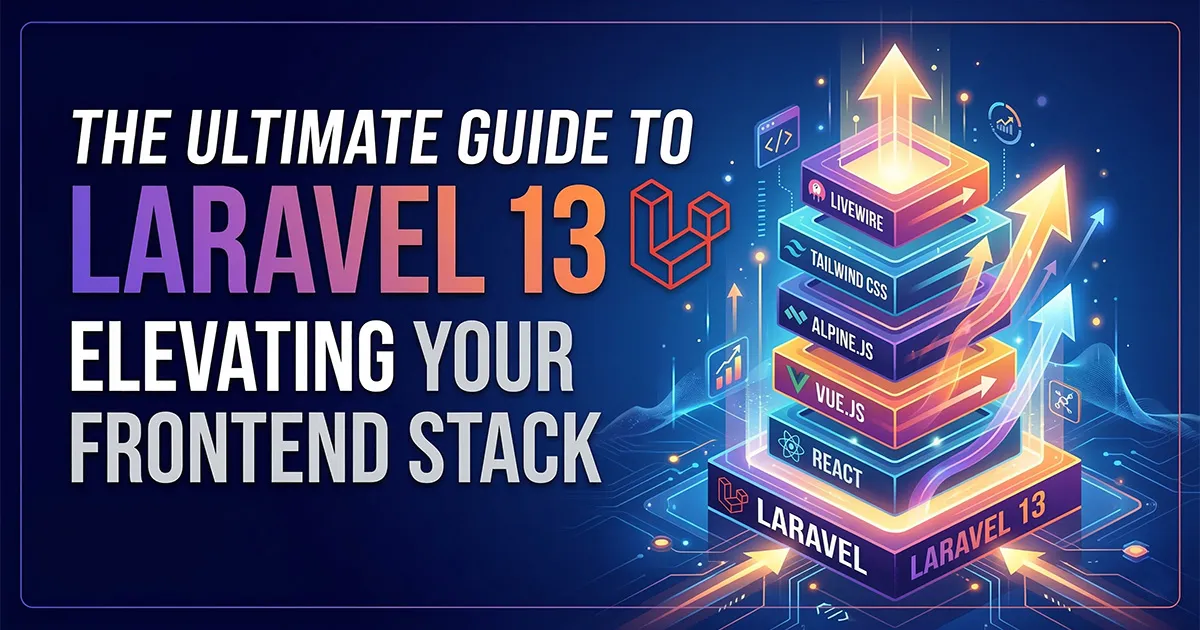
For the vast majority of startups in Bangladesh, I highly recommend using Laravel 13 in combination with Inertia.js. Inertia acts as the ultimate bridge between your Laravel backend and your React or Vue frontend.
In the past, to use React, your developers had to build two completely separate applications: a backend API to serve the data, and a frontend application to consume it. This meant double the work, double the bugs, and double the hosting costs. Inertia.js eliminates this completely. It allows your developers to pass data directly from the Laravel backend straight into your Vue or React components without ever building a separate API. You get the lightning-fast, highly interactive user interface of a Single Page Application (SPA), but with the simplicity and lower cost of a traditional website.
Routing Optimizations for Headless Architectures with Next.js
What if your business is scaling rapidly, and you need to build a native iOS and Android mobile app alongside your website? In that scenario, you will need a "headless" architecture. This means your Laravel 13 backend will act purely as an API engine, securely feeding data to a separate frontend framework like Next.js.
Laravel 13 introduces powerful routing optimizations and middleware setups that make headless integrations incredibly secure. When your Next.js application asks your Laravel backend for data, Laravel's optimized middleware seamlessly handles complex security checks like Cross-Origin Resource Sharing (CORS) and rate limiting, ensuring that hackers cannot overwhelm your servers with fake traffic. While building a headless Next.js application is more expensive and complex than using Inertia, Laravel 13 ensures your backend API remains fast, stable, and highly secure.
| Architecture Type | Best Frontend Pairing | Development Cost | Best Use Case for Startups |
| Modern Monolith | Inertia.js with Vue/React | Low to Medium | E-commerce sites, SaaS dashboards, and businesses needing rapid feature delivery without API overhead. |
| Headless API | Next.js (React) | High | Enterprise platforms requiring simultaneous deployment to web, iOS, and Android using a centralized data source. |
Performance and Queues: Managing Heavy Background Tasks
When a customer places an order on your website, several things need to happen behind the scenes. The system needs to generate a PDF invoice, process a credit card transaction, and send a confirmation email. If your application tries to do all of these things while the user is staring at a loading screen, they will get frustrated and close the browser.
To solve this, developers use Queues to push these heavy background tasks to the server's background, allowing the user's screen to load instantly. Laravel 13 introduces a new PHP attribute called #[MaxExceptions] for these queues. If an external service—like your email provider—goes down, #[MaxExceptions] tells your server exactly when to stop trying to send the email, preventing your entire application from crashing due to infinite loops.
Additionally, Laravel 13 introduces the Cache::touch() method. Caching is the process of storing frequently accessed data in high-speed memory so your database doesn't have to work as hard. Previously, if we wanted to keep that data in memory a little longer, the server had to redownload and re-upload the entire file. The new Cache::touch() method acts as a massive shortcut, simply telling the memory to extend the expiration timer with zero extra bandwidth. This backend enhancement is absolutely critical for managing heavy traffic in highly interactive, real-time web applications.
Speaking of real-time web apps, Laravel 13 also introduces a native database driver for Reverb, its WebSocket server. In the past, if you wanted to build live-chat features or real-time order tracking, you had to pay for expensive "Redis" servers. Now, smaller applications can scale horizontally using their existing database, minimizing infrastructure complexity and lowering your monthly hosting bills.
Practical Implementation: Laravel 13 in Action
To demonstrate how beautifully these new features come together, I have prepared a hands-on example. Below is a snippet showing how a Laravel 13 Model uses the new PHP Attributes, perfectly paired with a Vue 3 component using Inertia.js. Notice how clean and readable the backend code is.
The Laravel 13 Backend Model (Product.php):
namespace App\Models;

use Illuminate\Database\Eloquent\Model;
use Illuminate\Database\Eloquent\Attributes\Fillable;
use Illuminate\Database\Eloquent\Attributes\Table;

// We protect our data cleanly using PHP Attributes, avoiding mass assignment!
#
#[Fillable(['name', 'price', 'is_in_stock'])]
class Product extends Model {
    // The class body is beautifully empty, leaving room strictly for custom logic.
}
The Vue 3 Frontend Component (Products.vue):
<script setup lang="ts">
import { Link } from '@inertiajs/vue3'
// Inertia passes the product data directly from the backend to the frontend seamlessly!
defineProps<{ products: Array<{ id: number, name: string, price: number }> }>()
</script>

<template>
  <div class="product-grid">
    <div v-for="product in products" :key="product.id" class="card">
      <h3 class="font-bold">{{ product.name }}</h3>
      <p>Price: ৳{{ product.price }}</p>
      <Link :href="`/products/${product.id}`" class="btn-primary">
        View Details
      </Link>
    </div>
  </div>
</template>
This is the power of Laravel 13. Clean, secure backend code feeding directly into a lightning-fast frontend interface, giving your customers the premium experience they deserve.
Frequently Asked Questions (FAQ)
1. What exactly is a mass assignment vulnerability? Mass assignment happens when an application blindly accepts all data submitted in a user form and saves it to the database. If a hacker sneaks a hidden administrative field into their form submission, they could gain unauthorized control of your site. Laravel 13 prevents this by strictly requiring developers to declare safe fields using #[Fillable] attributes.
2. Should my startup use Inertia.js or a headless Next.js setup? For 90% of new businesses in Bangladesh, Inertia.js paired with Vue or React is the most cost-effective and efficient choice. It allows you to build a fast, app-like experience without the massive financial overhead of building and securing a separate API. Only choose Next.js if you are building an enterprise system that must simultaneously connect to native mobile applications.
3. Why does my website need to use queues for background tasks? If your website attempts to send an email, generate a PDF receipt, and process a payment while the user is waiting, the page will freeze. Queues push these heavy, time-consuming tasks into the background, allowing the user's screen to load instantly.
4. How does upgrading to PHP 8.3 save me money? PHP 8.3 is significantly more computationally efficient than older versions. Because it processes data faster and uses less memory, your application can handle more concurrent users without requiring you to purchase larger, more expensive cloud hosting servers.
5. Do I still need Redis for real-time chat features in Laravel 13? Not necessarily! While massive enterprise apps still need Redis, Laravel 13 introduces a new Reverb Database Driver. This allows small and medium-sized businesses to run real-time features (like live notifications or order tracking) using their standard database, eliminating the need to pay for and manage a separate Redis server.
Let's Build Your Digital Future Together
Navigating the complexities of modern web development can feel incredibly overwhelming, especially when you are pouring your energy into launching a new business. But I want to reassure you: with the right technology stack and the right guidance, your digital presence can become your greatest asset. Laravel 13 represents the pinnacle of high-performance, secure, and cost-effective web development. By embracing its PHP 8.3 baseline, its elegant attribute-based architecture, and its seamless integrations with React and Vue, you are setting your business up for long-term, scalable success.
You do not have to figure this out on your own. If you are confused about your current technology stack, experiencing slow website performance, or planning to build a new web application from scratch, we are here to help. Contact us immediately at naimbd.com for a comprehensive, empathetic website evaluation. Let our expert developers map out the perfect Laravel 13 architecture tailored specifically for your business goals.
Authoritative Sources for Further Reading:
-
Official Laravel Documentation: https://laravel.com/docs
-
Next.js Routing and Architecture Guidelines: https://nextjs.org/docs
-
Inertia.js Official Core Concepts: https://inertiajs.com/
-
The PHP 8.3 Release Foundation: https://www.php.net/releases/8.3/en.php