The decision-making process for enterprise-grade technology stacks in 2026 has transitioned from a debate over raw performance to a holistic evaluation of developer productivity, long-term maintainability, and ecosystem security. For a veteran full-stack developer with over a decade of experience navigating the shifting tides of web architecture, the choice between PHP/Laravel and Node.js often determines the ultimate success or failure of a large-scale project. While the "Node.js is the future" narrative dominated much of the mid-2010s, the current landscape of 2026 reveals a significant resurgence in Laravel adoption for enterprise systems. This shift is driven by the framework's maturity, its aggressive modernization of the PHP runtime, and its ability to provide a secure, standardized foundation in an era plagued by supply-chain vulnerabilities and fragmented JavaScript architectures.
The Resilience of the Silent Workhorse: Is PHP Dead 2026?
The perennial question regarding the relevance of PHP has become a recurring trope in the tech industry, yet the data in 2026 provides a resounding answer. Far from obsolescence, PHP remains the backbone of the modern internet, powering approximately 72.4% to 75% of all websites where the server-side language is known. This enduring presence is not merely a result of legacy WordPress installations; it is a testament to the language's capacity for evolution. PHP 8.3, 8.4, and the emerging 8.5 versions have introduced features such as property hooks, typed class constants, and advanced JIT (Just-In-Time) compilation that place it on par with or ahead of other server-side runtimes in terms of type safety and developer ergonomics.
Enterprise organizations prioritize stability and a proven track record. The analysis indicates that 60% of the PHP market share is currently occupied by Laravel, cementing its position as the premier framework for professional PHP development. For companies like the BBC, Etsy, and Alibaba, the "proven stability" of the PHP ecosystem offers a level of reliability that newer, more volatile environments struggle to match. The reputation of PHP as "spaghetti code" has been systematically dismantled by Laravel’s adherence to the Model-View-Controller (MVC) architecture, which enforces a separation of concerns that is critical for long-term maintenance in enterprise environments.
| Market Usage Statistics (2026) | PHP / Laravel | Node.js (JavaScript) |
| Global Server-Side Market Share |
72.5% |
5.4% |
| Enterprise Adoption Logic |
Proven Stability / Security |
Real-time / Concurrency |
| Framework Preference |
Laravel (60% of PHP share) |
Express, NestJS, Fastify |
| Community Size |
2.5M+ Developers |
15M+ Developers |
Despite the massive 15-million-strong JavaScript developer pool, the concentration of developers specialized in enterprise backend architecture is remarkably high within the Laravel community. This specialized talent pool, often referred to as "artisans," focuses on building robust business logic rather than merely configuring build tools, which is a common bottleneck in the Node.js ecosystem.
Laravel vs Nodejs for Enterprise: Technical Architecture and Performance
The performance gap that once existed between Node.js and PHP has been significantly bridged by the introduction of persistent application servers. Traditionally, PHP’s request-per-process model—where the entire framework boots for every HTTP request—was its Achilles' heel. In 2026, the widespread adoption of Laravel Octane and FrankenPHP has changed the paradigm.
The Persistence Revolution: Octane and FrankenPHP
Laravel Octane supercharges performance by keeping the application in memory between requests using high-powered servers like Swoole, RoadRunner, or FrankenPHP. FrankenPHP, written in Go, provides a worker mode that allows the application to boot once and stay resident, enabling it to handle subsequent requests with near-instantaneous response times. This persistence eliminates the bootstrapping overhead that previously limited PHP to 2,000-3,000 requests per second. With Octane and FrankenPHP, Laravel applications can now achieve 500,000 to 1,000,000 requests per second, placing them in the same league as Node.js frameworks like Fastify.
| Performance Benchmarks (2026) | Traditional PHP | Laravel Octane (Worker) | Node.js (NestJS/Fastify) |
| Mean RPS (Concurrent Load) |
~7,000 |
22,675+ |
585 (NestJS) - 1M+ (Native) |
| P95 Latency (ms) |
2.022 |
23.365 (High Load) |
95.67 |
| Bootstrapping Overhead | High (Every Request) |
Zero (Persistent) |
Zero (Persistent) |
While Node.js still maintains a theoretical edge in raw throughput for lightweight, I/O-bound tasks due to its non-blocking event loop, the real-world performance difference for enterprise CRUD applications is negligible. Most enterprise systems are bottle-necked by database queries and external API calls rather than the runtime's execution speed. In these scenarios, the structured backend processing of Laravel is often more efficient at managing complex business logic than the single-threaded event loop of Node.js, which can become blocked during CPU-intensive tasks.
Handling CPU-Intensive Tasks
A critical architectural distinction lies in how these environments handle heavy computation. Node.js operates on a single-threaded event loop. If a request involves complex calculations or encryption, it can block the loop, causing latency spikes for all other concurrent users. Laravel, utilizing worker processes (either through PHP-FPM or Octane), isolates each request into its own worker. If one worker is blocked by a heavy task, the remaining workers continue to process other requests unhindered, providing a more resilient experience for enterprise users who require consistent performance under varying workloads.
Security and the Supply Chain Crisis: Why Choose Laravel
In the 2025 and 2026 calendar years, the tech industry has witnessed an unprecedented surge in supply-chain attacks targeting the NPM registry. The Node.js ecosystem’s reliance on thousands of small, third-party packages has created a massive attack surface. The "Shai-Hulud" and "S1ngularity" attacks in late 2025 demonstrated how a single compromised developer's token could lead to a worm-like infection across hundreds of libraries, exfiltrating AWS credentials and SSH keys from enterprise environments.
Standardized Core vs. Fragmented Dependencies
Laravel adopts a "batteries-included" philosophy, where critical features such as authentication, authorization, CSRF protection, and encryption are built into the core framework and maintained by the primary development team. This significantly reduces an organization’s dependency on unverified third-party libraries. In contrast, Node.js is unopinionated, often requiring developers to assemble a stack from disparate NPM packages for even basic security functions like rate limiting or session management.
-
Laravel Security: Includes built-in protection against SQL injection (via Eloquent ORM), Cross-Site Scripting (XSS), and Cross-Site Request Forgery (CSRF). It utilizes the Bcrypt hashing algorithm for password security and provides automated session handling out of the box.
-
Node.js Security: Security measures depend heavily on the chosen libraries (e.g., Helmet, CSURF). Developers must be proactive in applying security best practices across a fragmented dependency tree, which increases the likelihood of human error or oversight.
Recent security releases for the Node.js runtime in early 2026 addressed high-severity vulnerabilities like CVE-2025-55131 (uninitialized memory exposure) and CVE-2025-55130 (permission model bypass via symlinks). For an enterprise, the constant need to monitor and patch these low-level runtime vulnerabilities—combined with the risk of NPM supply chain attacks—often makes the more consolidated and vetted Laravel ecosystem a safer strategic bet.
Developer Economics: Total Cost of Ownership and Productivity
The true cost of an enterprise application is not the server bill, but the thousands of developer hours spent on building, testing, and maintaining the code. Laravel’s convention-over-configuration approach provides a clear economic advantage over the more flexible but fragmented Node.js ecosystem.
Productivity and Time-to-Market
Evidence suggests that a Laravel developer can scaffold a functional enterprise MVP in approximately 2-3 weeks, whereas the same task would require 4-6 weeks in a Node.js environment. This discrepancy arises because Node.js developers must spend significant time assembling infrastructure, selecting middleware, and defining project patterns, while Laravel provides these as standard conventions.
| Economic Factor | Laravel / PHP | Node.js / JavaScript |
| Initial Development Speed |
High (Convention-based) |
Moderate (Pattern selection) |
| Maintenance Overhead |
Lower (Standardized) |
Higher (Architectural entropy) |
| Average Developer Rate |
$30 - $90 / hr |
$40 - $120 / hr |
| Hiring Availability |
Large, Affordable Pool |
High Demand, Premium Rates |
The structured nature of Laravel also reduces "architectural entropy." When an enterprise rotates developers onto a project, a Laravel developer can become productive almost immediately because every Laravel project follows the same directory structure and coding standards. In the Node.js world, every project can have a unique architecture, requiring longer onboarding times and increasing the risk of technical debt as multiple developers impose different patterns on the same codebase.
Total Cost of Ownership (TCO)
While Node.js may offer lower infrastructure costs for high-concurrency real-time apps, Laravel’s lower development and maintenance costs often result in a superior ROI for standard enterprise applications. Hiring costs for Node.js developers are generally higher, especially in North America and Europe, whereas Laravel talent is widely available across South Asia, Eastern Europe, and Latin America, offering high-quality development at more competitive rates.
Deep Dive: Laravel 13 and the Future of Enterprise PHP
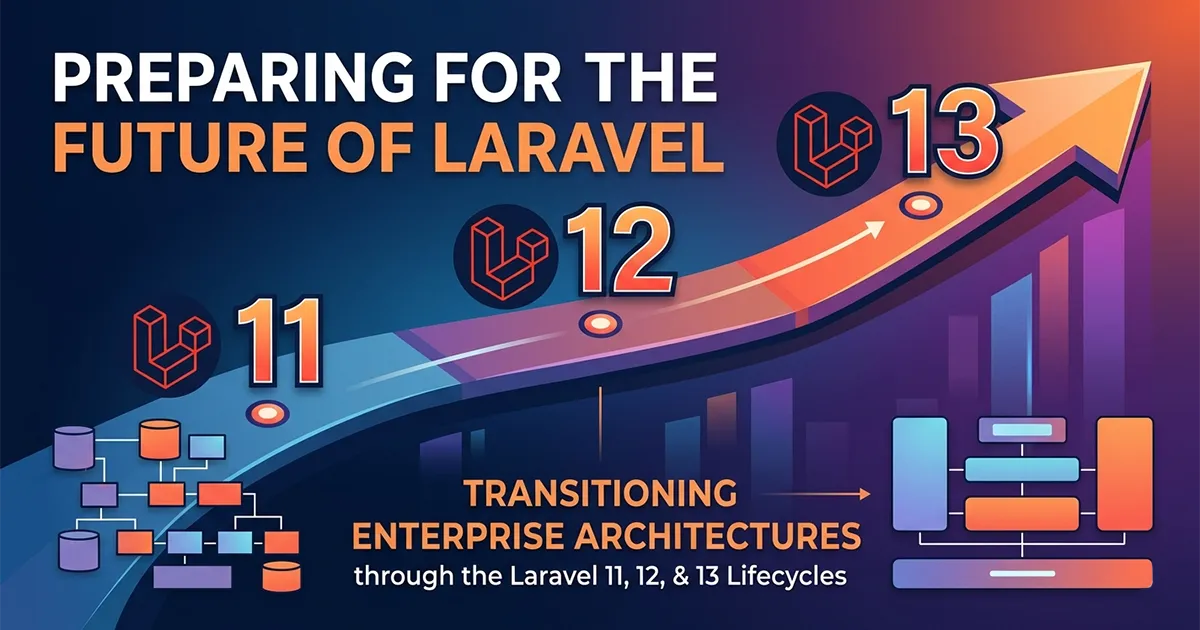
The Q1 2026 release of Laravel 13 marks a significant milestone in the framework's commitment to enterprise-grade stability and modern technology. By mandating PHP 8.3 and higher, Laravel 13 sheds the weight of legacy polyfills and focuses on the optimizations provided by recent PHP versions.
Key Enterprise Features in Laravel 13
-
Enhanced Stability and Type Safety: The framework has been stripped of deprecated backward-compatibility layers, forcing a cleaner dependency tree and better type safety through the use of native PHP 8.3 features like typed class constants and the
#[Override]attribute. -
Cache Lifetime Optimization: The introduction of the
Cache::touch()method allows developers to extend the TTL of a cached item without the overhead of retrieving it from the store, a critical feature for high-traffic enterprise caching strategies. -
Hardened Model Booting: Laravel 13 prevents the instantiation of new Eloquent models during the
boot()method of a model, a change that prevents side-effect-driven bugs in complex data models. -
Subdomain Routing Improvements: Routing priority has been updated to ensure subdomain-specific routes take precedence over generic routes, simplifying the development of multi-tenant enterprise SaaS applications.
-
Real-Time Scaling with Reverb: The database driver for Laravel Reverb (the framework's first-party WebSocket server) allows smaller enterprise deployments to scale horizontally without requiring a complex Redis setup for channel state.
These advancements, combined with the power of the JIT compiler in PHP 8.4, result in a 5-10% throughput improvement for compute-heavy workloads simply by upgrading the runtime. For enterprises, this means more efficient resource utilization and better performance for API gateways and financial calculation engines.
The Ecosystem Advantage: From Provisioning to Observability
One of the most compelling reasons why veterans choose Laravel is the unparalleled first-party ecosystem. In the Node.js world, developers often rely on a patchwork of third-party SaaS tools for deployment, monitoring, and server management. Laravel provides a unified, deeply integrated suite of tools that work seamlessly with the framework.
-
Laravel Forge & Vapor: Forge automates server provisioning and deployment for traditional cloud environments, while Vapor offers a serverless deployment platform on AWS that handles auto-scaling and zero-downtime deployments with ease.
-
Laravel Pulse & Telescope: Pulse provides a real-time dashboard for monitoring application health and server performance, while Telescope acts as a comprehensive debug assistant, tracking database queries, exceptions, and mail entries during development.
-
Laravel Horizon: Manages high-traffic Redis queues with a dedicated dashboard, allowing enterprises to monitor job throughput and retry failed background tasks with precision.
-
Laravel Nova: Generates a professional, feature-rich admin panel for data models with minimal configuration, saving hundreds of hours of manual dashboard development.
This cohesive ecosystem allows a small team of developers to manage an infrastructure that would typically require a dedicated DevOps department in other language environments.
Case Studies: Enterprise Adoption in 2026
The enterprise adoption of Laravel in 2026 spans various industries, from healthcare and finance to global logistics. Large engineering studios like PixelCrayons and OrangeMantra have delivered thousands of Laravel projects for global brands like Samsung, BMW, and Volkswagen.
-
Healthcare Compliance: Firms like Curotec leverage Laravel's robust security and structured architecture to build HIPAA-compliant data portals and patient management systems.
-
Financial Services: Redberry, an official Diamond-tier Laravel partner, uses the framework to build banking platforms and FinTech applications for major institutions like the Bank of Georgia.
-
E-commerce and Logistics: Wildnet Edge engineers sophisticated logistics ecosystems where Laravel backends manage real-time global transactions and AI-powered fraud detection.
These case studies highlight that when security, reliability, and structured development are the primary requirements, Laravel is the preferred choice for enterprises that cannot afford the "move fast and break things" volatility associated with many modern JavaScript frameworks.
Conclusion: The Strategic Choice for 2026
The comparison between Laravel and Node.js for enterprise applications in 2026 is no longer a question of whether PHP is "dying." Instead, it is a question of architectural maturity and economic efficiency. While Node.js remains a powerful tool for real-time applications and microservices where raw concurrency is the only metric that matters, Laravel has proven itself to be the superior all-around choice for complex, secure, and maintainable enterprise software.
Laravel’s ability to combine the elegance of PHP 8.4 with a persistent application server architecture (FrankenPHP) has eliminated the performance gap. Meanwhile, its standardized core and first-party ecosystem provide a level of security and developer productivity that Node.js struggles to match. For a veteran developer, the choice of Laravel is a choice for a stable, predictable, and highly efficient development lifecycle—one that protects the enterprise's bottom line and ensures long-term success in an increasingly complex digital landscape.