If you have spent any time on developer forums or LinkedIn recently, you have likely seen the panic. Developers are reporting that they have to apply to 200 or 300 jobs just to get a single callback. The job market feels frozen, AI recruitment tools are screening resumes, and everywhere you look, there is a new viral video of an artificial intelligence agent building a fully functional web application in sixty seconds. It is enough to make anyone question their career choices.
As someone who has spent the last 12 years working as a full-stack developer transitioning from jQuery spaghetti code to modern serverless architectures I want to give you a reality check. The question "is AI replacing programmers?" is the wrong question to ask.
AI is not a developer; it is a power tool.
Think about the construction industry. A carpenter with a modern, battery-powered drill is exponentially faster than a carpenter using a manual screwdriver. The power drill drives the screws in a fraction of a second, saving time and physical effort. But the power drill does not know where the load-bearing walls are. It does not understand local building codes, and it certainly cannot design a house that will withstand a hurricane. You still need to be a master carpenter to know where to put the screws.
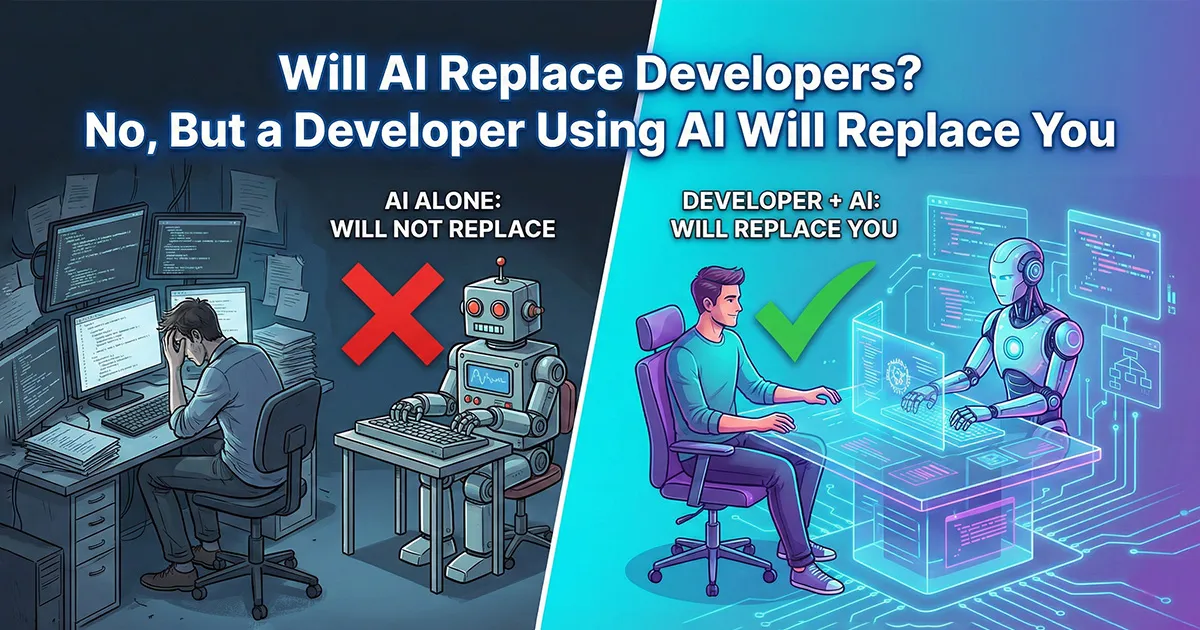
The future of coding jobs belongs to the digital carpenters who know how to wield these massive AI power tools. If you refuse to use the drill, you will be outpaced and replaced by someone who does.
The Hard Data: Why You Must Evolve in 2026
We are no longer guessing about the impact of AI on software engineering; we have concrete data. In the past year, the industry has undergone a tectonic shift from traditional manual scripting to what is now known as "agentic coding".
By July 2025, GitHub Copilot had reached over 20 million cumulative users, representing a staggering 400% year-over-year growth. Today, over 95% of professional developers admit to regularly using AI-generated code in their production environments.
If you think these developers are just using AI as a glorified autocomplete, look at the telemetry data. AI now generates an average of 46% of all code written by its users, and for some languages like Java, that number spikes to 61%. In controlled experiments where developers were tasked with building a JavaScript HTTP server, the group using AI completed the task 55% faster than the group writing code manually.
Enterprise companies are seeing the financial and operational benefits. A recent McKinsey report tracking high-performing software organizations revealed that teams deeply integrating AI saw a 16% to 30% improvement in overall productivity, alongside a massive 31% to 45% improvement in software quality. Furthermore, independent case studies, like those from Accenture, report an 84% increase in successful, error-free builds when developers use AI assistants.
The math is simple: a developer using AI can do the work of two traditional developers, with fewer bugs and faster merge times. That is why the traditional developer is at risk of being replaced not by the machine itself, but by the highly efficient human operating it.
The Rise of "Vibe Coding" and System Orchestration
A term that has completely taken over the industry in 2026 is "vibe coding". Named the Word of the Year by Collins Dictionary, vibe coding refers to the practice of using natural language and AI agents to automate the generation of application code. In this new paradigm, English (or any natural language) has effectively become the world's most popular programming language.
With vibe coding, the "Time to Tool" the latency between identifying a business problem and deploying a custom software solution has collapsed from months down to mere days. You simply prompt the AI, guide its architectural decisions, and let it write the boilerplate.
However, this is where the "AI will replace us all" narrative falls apart. AI is incredibly good at writing isolated, well-documented software patterns like spinning up a Python FastAPI backend connected to a PostgreSQL database with a standard React frontend. But the majority of highly profitable, mission-critical enterprise software does not look like a neat tutorial.
When you drop an AI into a massive, undocumented, five-year-old custom codebase, it struggles. It often generates gibberish or attempts to rewrite logic without respecting the established, complex idioms of the project. Sometimes, maintaining a consistent (even if slightly flawed) code structure is more important for a business than perfectly optimized, AI-generated fragments.
To succeed in agentic engineering, you must possess a deep understanding of computer science fundamentals. You cannot efficiently direct an AI to build an application if you do not know how cloud infrastructure works, how to design a scalable database schema, or how to spot a glaring security vulnerability. The modern developer has transitioned from being a "manual scripter" to a "system orchestrator".
Traditional Developer vs. AI-Empowered Developer
To understand what the future of coding jobs looks like, we need to compare the old way of working with the new 2026 standard.
| Feature | Traditional Developer | AI-Empowered Developer (2026) |
| Primary Output | Manually typing syntax and boilerplate code. | System design, prompt engineering, and code review. |
| Development Speed | Limited by typing speed and manual documentation searches. | Completes tasks up to 55% faster using AI generation. |
| Problem Solving | Spends hours debugging missing semicolons or syntax errors. | Uses AI to instantly spot syntax errors; focuses on complex logic. |
| Skill Focus | Memorizing specific language syntax (e.g., React, Python). | Cross-language adaptability, cloud architecture, and security. |
| Job Security | Decreasing. Easily replaced by more efficient workflows. | High. Acts as the critical "human-in-the-loop" for enterprise AI. |
What Does This Mean for Junior Developers?
One of the biggest concerns regarding AI replacing programmers centers around entry-level jobs. It is true that the landscape is shifting; reports indicate a severe structural decline in traditional entry-level tech roles. The tasks historically assigned to junior developers writing simple unit tests, documenting code, and fixing minor boilerplate bugs are exactly the tasks that AI agents excel at automating.
Does this mean nobody will ever be hired as a junior again? Absolutely not.
Comparing AI to junior developers is fundamentally flawed and ignores the human element of software engineering. Junior developers bring immense value that a Large Language Model cannot replicate: they offer fresh ideas, they possess the energy to try bold new approaches, and they adapt to company culture. More importantly, humans learn from failure and grow into senior leaders, whereas an AI model remains static until its next training run.
The reality for junior developers in 2026 is that the baseline has moved. You can no longer get hired just because you know how to center a <div> or write a basic SQL query. You must enter the job market with a higher level of architectural understanding. You must learn how to "pair program" with AI agents, knowing exactly what prompts to ask, where to look for hallucinations, and when to step in and manually correct the logic.
How to Future-Proof Your Career
The developers who are thriving right now are the ones who have accepted that their job title is "Problem Solver," not "JavaScript Typist." To secure your place in the future of coding jobs, you must elevate your skill set above the code itself.
Focus heavily on system design and distributed cloud architectures. Learn how microservices communicate, how data pipelines scale, and how to design resilient databases. Because AI allows us to build software faster than ever, the emphasis has shifted heavily toward security. Understanding how to embed security architectures into agentic systems from the very beginning is a highly sought-after skill.
Stop fearing the drill. Pick it up, learn its quirks, understand its limitations, and start building things faster and better than you ever could before. The AI will not replace you, but the developer sitting next to you who mastered vibe coding absolutely will.