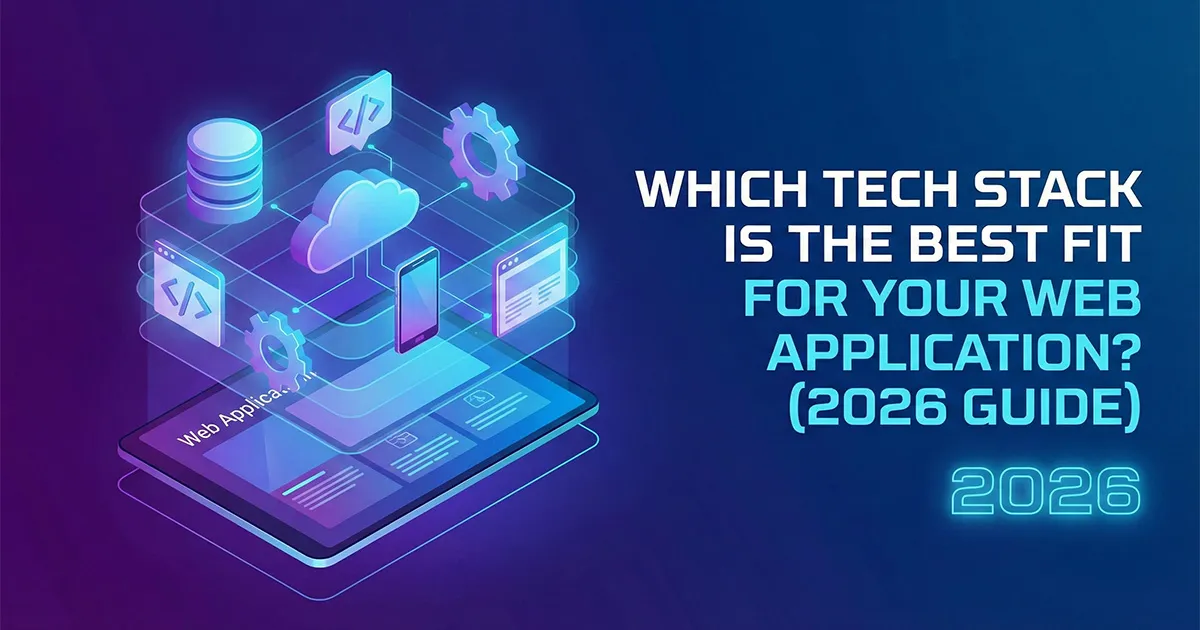
One of the first—and most critical—decisions you will make when building a web application is choosing the right Tech Stack.
Think of a tech stack like the foundation and materials for a house. If you build a skyscraper with wood, it will collapse. If you build a doghouse with steel beams, you are wasting money.
The "Stack" is simply the combination of programming languages, frameworks, and tools used to build your app. Typically, it involves a Backend (server-side) and a Frontend (client-side).
With so many buzzwords flying around—Laravel, React, MERN, Angular, Python—how do you choose?
In this guide, we will break down the top contenders for 2026 to help you decide which one fits your project, budget, and business goals.
1. Laravel + Blade (The "Rapid & Reliable" Choice)
Best For: Small to Medium Business (SMB) websites, MVPs, and content-heavy platforms.
If you need to launch quickly and keep costs low, this is your winner. Laravel is the most popular PHP framework in the world, known for its elegant syntax and security. Blade is its built-in templating engine.
-
Why choose it? It is a "Monolith" structure. You don't need to manage two separate applications (frontend and backend). Everything lives in one place. It is incredibly fast to develop, easy to maintain, and SEO-friendly out of the box.
-
The Trade-off: It feels slightly less "app-like" than modern JavaScript frameworks. If you need a page to update instantly without refreshing (like Facebook), you might want a more powerful frontend.
Verdict: Great for e-commerce stores, directories, and standard business tools.
2. Laravel + Vue.js (The "Developer’s Favorite")
Best For: Interactive dashboards, single-page applications (SPAs), and dynamic user interfaces.
This is the "Sweet Spot" for many developers. Laravel handles the heavy lifting on the server (security, database), while Vue.js handles the user interface.
-
Why choose it? Vue is lightweight and integrates beautifully with Laravel. It allows you to build "reactive" components—meaning if a user clicks a button, the data updates instantly without reloading the page. It offers a smooth, modern user experience (UX) without the extreme complexity of React.
-
The Trade-off: It requires developers who know both PHP and JavaScript, but the learning curve is gentler than React or Angular.
Verdict: The perfect balance of performance and development speed for most modern web apps.
3. Laravel + React.js (The "Scalable Giant")
Best For: Large-scale SaaS platforms, complex social networks, and apps with mobile counterparts.
React.js (maintained by Meta/Facebook) is the industry standard for frontend interfaces. Pairing it with Laravel’s robust backend gives you an enterprise-grade solution.
-
Why choose it? React is component-based and massive. If you plan to hire a large team later, finding React developers is easy. Plus, if you build your web app in React, you can easily convert it to a mobile app later using React Native.
-
The Trade-off: It adds complexity. You are essentially managing two separate apps (Laravel API + React Frontend). Communication between them requires careful planning.
Verdict: Choose this if you are building the next Airbnb or Uber and have a moderate-to-high budget.
4. Laravel + Next.js (The "SEO & Performance King")
Best For: High-traffic media sites, large e-commerce marketplaces, and SEO-critical apps.
Next.js is a framework built on top of React. It solves React's biggest problem: SEO. Standard React apps run in the browser (Client-Side Rendering), which Google sometimes struggles to read. Next.js renders on the server (Server-Side Rendering), making it lightning-fast and Google-friendly.
-
Why choose it? You get the interactivity of React with the SEO ranking power of a traditional site. Combined with Laravel as an API backend, this is a top-tier, modern stack.
-
The Trade-off: Higher hosting complexity and development cost.
Verdict: The premium choice for projects where ranking #1 on Google is the main goal.
5. MERN Stack (MongoDB, Express, React, Node.js)
Best For: Real-time applications (chat apps, collaboration tools), startups, and "All-JS" teams.
The MERN Stack is unique because it uses JavaScript for everything—database, backend, and frontend.
-
Why choose it? It handles high concurrency (many users doing things at once) extremely well. Because the entire code is in one language (JS), communication between frontend and backend is seamless. It’s a favorite for Silicon Valley startups.
-
The Trade-off: MongoDB is a NoSQL database, which is great for unstructured data but can be tricky for complex financial data or rigid relationships (where SQL/Laravel shines).
Verdict: Ideal for social platforms, live streaming apps, or tools like Trello/Slack.
6. Laravel + Angular (The "Strict & Structured")
Best For: Enterprise-level banking, healthcare, or logistics software.
Angular (maintained by Google) is a heavy-duty frontend framework. It forces developers to write code in a very specific, strict way (using TypeScript).
-
Why choose it? It is incredibly stable. In large teams where 50 developers are working on the same code, Angular prevents "spaghetti code." When paired with Laravel, you get a secure backend with a highly structured frontend.
-
The Trade-off: The learning curve is steep. It is often "overkill" for simple projects.
Verdict: Choose this only if you are building a massive, long-term enterprise system.
7. ASP.NET + Angular (The "Corporate Standard")
Best For: Government portals, large corporate intranets, and systems requiring high security.
ASP.NET (by Microsoft) is the big brother of the web world. It is typed, compiled, and incredibly fast.
-
Why choose it? Security and integration. If your company already uses Microsoft Azure, Active Directory, or Windows Servers, this is the natural choice. It is built for performance and security compliance.
-
The Trade-off: It is expensive. Developers cost more, hosting costs more, and development time is slower than Laravel or Node.js.
Verdict: The go-to for Fortune 500 companies and government projects.
8. Python + Next.js (The "Data & AI" Stack)
Best For: AI-driven apps, Fintech, Data Science platforms, and Machine Learning tools.
Python (using frameworks like Django or FastAPI) is the language of AI.
-
Why choose it? If your app needs to recommend products, analyze stock markets, or process images using AI, Python is essential on the backend. Next.js ensures the frontend remains fast and user-friendly.
-
The Trade-off: Python is slightly slower than Node.js or Go for simple web requests, though modern frameworks like FastAPI are closing that gap.
Verdict: Essential if your "Secret Sauce" involves Artificial Intelligence or heavy data processing.
Summary: How to Choose?
Still not sure? Here is the cheat sheet:
| If your priority is... | Choose this Stack |
| Speed to Market & Low Cost | Laravel + Blade |
| User Experience & Interactivity | Laravel + Vue.js |
| Scalability & Mobile App Potential | Laravel + React.js |
| SEO & High Traffic | Laravel + Next.js |
| Real-Time Data (Chat/Social) | MERN Stack |
| Enterprise Structure & Stability | Laravel + Angular |
| Corporate Security & Compliance | ASP.NET + Angular |
| AI & Data Science | Python + Next.js |
Final Advice
There is no "perfect" stack—only the right stack for your project. Don't chase the hype; chase the solution that fits your business goals.
If you are looking for a team that can handle Laravel, React, or Next.js expert development, you need a partner who understands both the code and the business logic.