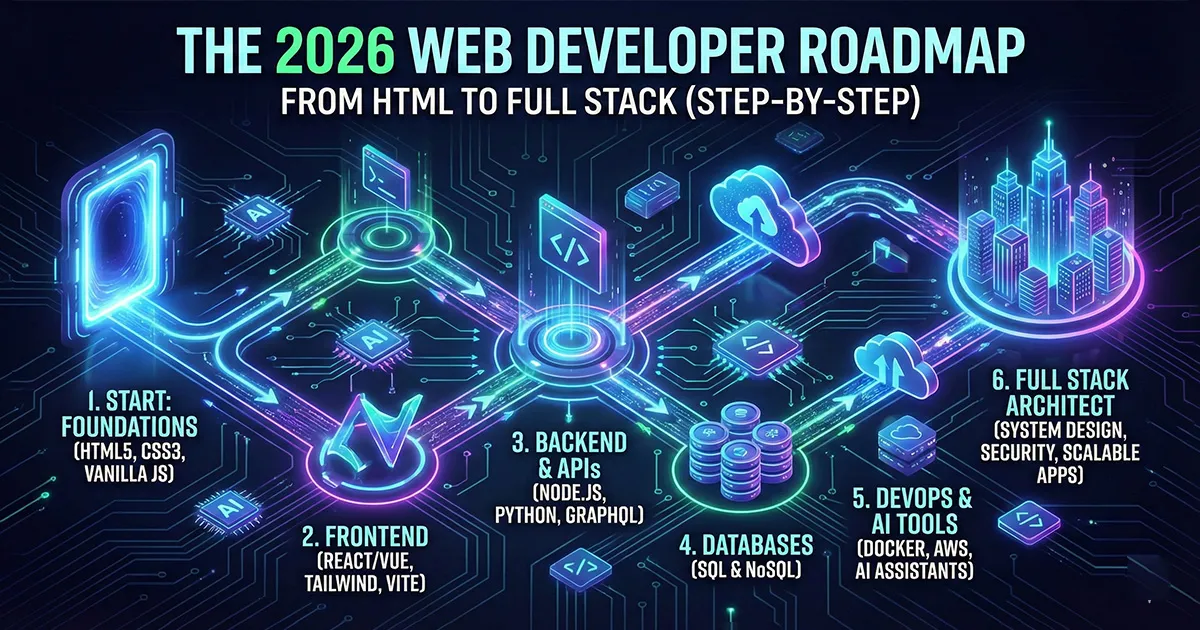
The digital landscape has undergone a monumental transformation. As the technology sector progresses through 2026, the traditional boundaries that once separated frontend interfaces, backend logic, and database management have largely dissolved. Modern web development is now characterized by highly integrated, type-safe meta-frameworks, the omnipresence of artificial intelligence in the coding process, and strict performance metrics dictated by Search Experience Optimization (SXO).
For individuals entering the field, the sheer volume of acronyms, frameworks, and conflicting advice can be paralyzing. The objective is no longer to learn every available technology, but rather to master the correct technologies in the optimal sequence. This exhaustive research report delineates the definitive 2026 roadmap for full-stack web development. By synthesizing recent industry benchmarks, including the Stack Overflow 2025 Developer Survey, real-world salary data, and search engine algorithmic shifts, this guide provides a step-by-step architectural breakdown from basic markup to advanced API integration.
Phase 1: The Foundation HTML5, CSS3, Vanilla JavaScript (ES6+)
Before interacting with complex architectural abstractions, artificial intelligence tools, or modern meta-frameworks, mastery of the web's foundational layer—often referred to as the "Holy Trinity"—is non-negotiable. These three core technologies are embedded in approximately 99% of all existing websites and remain the standard starting point for software engineering.
HTML5: The Semantic Skeleton
HyperText Markup Language (HTML) functions as the skeleton of a web page, defining its structure and content. In 2026, HTML has evolved far beyond visual formatting; it is the primary vector for conveying machine-readable context to search algorithms. With search engines increasingly relying on generative AI models to synthesize answers directly on the results page, the semantic structure of HTML is critical for Search Experience Optimization.
Utilizing precise semantic tags (such as <article>, <nav>, and <aside>) rather than generic <div> containers directly influences a website's E-E-A-T (Experience, Expertise, Authoritativeness, Trustworthiness) evaluation. Furthermore, properly structured HTML, complete with accessible attributes (a11y) and logical hierarchical headings, forms the basis for frictionless navigation, ensuring the application can be accurately parsed by both human users utilizing assistive technologies and AI systems aggregating data.
CSS3: The Skin and Native Logic
Cascading Style Sheets (CSS) dictate the visual presentation, making websites responsive, modern, and aesthetically pleasing. Moving into 2026, CSS has matured significantly, absorbing responsibilities that were previously delegated exclusively to JavaScript.
The widespread implementation of CSS Container Queries represents the most powerful responsive design feature since the advent of CSS Grid. Unlike traditional media queries that adjust styling based on the dimensions of the global browser viewport, container size queries permit individual user interface components to adapt independently based on the size of their parent container. This advancement allows for true modular component design. Additionally, modern CSS features like native nesting and advanced mathematical functions (e.g., sibling-index() and sibling-count()) allow developers to stagger animations and dynamically adjust layouts based purely on the Document Object Model (DOM) structure. By executing these calculations via the browser's native CSS engine rather than the JavaScript main thread, applications achieve drastically lower interaction latency.
Vanilla JavaScript (ES6+): The Brain and Muscle
JavaScript is the mechanism that adds interactivity to the web—processing forms, updating dynamic content, and handling user inputs. It remains the undisputed standard for client-side execution, boasting a 66% adoption rate among professional developers. A robust understanding of core concepts such as variables, functions, asynchronous execution (Promises and Async/Await), and DOM manipulation is essential before adopting any framework.
This learning phase is historically recognized as the most challenging, often referred to as the "Valley of Despair" for beginners transitioning from declarative markup to functional programming logic. However, the language itself has become more developer-friendly. A major milestone in 2026 is the stabilization of the Temporal API, which shipped by default in Firefox 139 and Chrome 144. For decades, developers struggled with JavaScript's legacy Date object, which was notoriously unreliable for timezone conversions. The Temporal API introduces immutable, time-zone-aware objects, effectively rendering the legacy Date object obsolete and eliminating the need to import heavy, third-party date manipulation libraries.
Phase 2: Choosing a Frontend Framework React vs. Vue vs. Angular
Once the vanilla foundation is established, modern development requires the adoption of a frontend framework. In 2026, frameworks are rarely utilized in their "raw" state; instead, they serve as the rendering engines for comprehensive meta-frameworks that handle routing, server-side rendering (SSR), and data fetching conventions.
Why React is the Industry Standard
React continues to dominate the frontend ecosystem, maintaining approximately 40% of the market share and boasting a massive open-source community with over 241,000 GitHub stars. It is widely considered the default choice due to its sheer "ecosystem gravity". React offers the broadest global job market, the largest talent pool, and maximum flexibility for teams intending to build cross-platform applications (expanding from web to mobile via React Native).
React is almost exclusively deployed alongside its premier meta-framework, Next.js. The Next.js architecture prioritizes edge rendering, Incremental Static Regeneration (ISR), and deep integration with modern cloud platforms. With the rollout of React 19.2, the framework introduced a native React Compiler, which automates memoization and eliminates the manual performance optimization overhead previously required by developers. While its extensive capabilities can result in slightly larger core bundle sizes (approximately 31.8KB to 40KB), its aggressive automatic batching and concurrent rendering capabilities yield exceptional runtime performance, clocking render speeds around 16ms.
Why Vue is Easier and Highly Effective
While React holds the enterprise crown, Vue.js has solidified its position as the preferred alternative, capturing approximately 22% of the market. Vue is celebrated for its progressive architecture, which provides a significantly gentler learning curve and a lower barrier to entry. Developers consistently report that Vue's syntax is cleaner, more organized, and easier to read, making it the fastest route to shipping products for solo developers, startups, and smaller teams.
Vue is typically paired with Nuxt, a meta-framework that minimizes configuration and emphasizes convention. In 2026, Vue 3.5 introduced "Vapor Mode," an opt-in compilation strategy that completely bypasses the Virtual DOM. By compiling components into highly efficient code that manipulates the DOM directly, Vue achieves sub-1ms patching for small components. This architectural pivot allows Vue to deliver ultra-fast render speeds (approximately 12ms), faster hydration latency (25–45ms), and remarkably small core bundle sizes (around 18–22KB).
Angular: The Enterprise Heavyweight
Angular, maintained by Google, holds roughly 18% of the market. It remains the standard for large-scale organizations—such as banks, government agencies, and telecommunications firms—that require a "batteries-included" platform. Angular is inherently rigid, enforcing strict architectural conventions, built-in dependency injection, and comprehensive HTTP patterns.
Historically criticized for its steep learning curve, Angular 19 has undergone a radical transformation. The framework is now fully "Zoneless," utilizing a native Signals API for fine-grained reactivity, completely eliminating the need for zone.js to track asynchronous operations. This architectural shift has reduced Angular's traditionally heavy bundle size by up to 30% and vastly improved its execution predictability, cementing its status as the safest bet for massive, enterprise-scale codebases.
2026 Frontend Framework Comparison
| Metric / Feature | React 19.2 (with Next.js) | Vue 3.5 (with Nuxt) | Angular 19 |
| Market Share (Est.) |
~40% |
~22% |
~18% |
| Learning Curve |
Moderate (Flexible/Unopinionated) |
Easy (Progressive/Clean) |
Steep (Strict/Opinionated) |
| Core Bundle Size |
~31.8KB |
~18-22KB |
~50-60KB (Optimized) |
| Reactivity Model |
Virtual DOM / React Compiler |
Fine-Grained / Vapor Mode |
Zoneless Signals |
| Primary Use Case |
Ecosystem scale, cross-platform |
Rapid shipping, Startups, MVPs |
Enterprise systems, Government |
Phase 3: Backend Basics The Necessity of a Server
While the frontend manages the user interface, the backend is responsible for the application's core functionality. Backend development handles business logic, database interactions, user authentication, and system security. Without a backend, an application is merely a static display; the server is the engine that powers dynamic software.
In 2026, backend architecture has increasingly embraced Serverless Architecture (Function as a Service - FaaS). By utilizing platforms like AWS Lambda and Azure Functions, developers can execute backend logic without provisioning or manually maintaining traditional server infrastructure, optimizing both scalability and cost. Choosing the correct backend language depends entirely on the application's domain.
Node.js: The Unified Ecosystem
Node.js remains the dominant backend runtime, utilized by 48.7% of professional developers. Its primary advantage is the unification of the technology stack: full-stack developers can write both frontend and backend logic utilizing JavaScript and TypeScript. Node.js operates on an event-driven, non-blocking I/O model, making it exceptionally efficient for handling numerous concurrent connections. This makes it the premier choice for real-time applications, chat platforms, and high-frequency data streaming. Combined with frameworks like Express.js (19.9% usage), the Node ecosystem offers unparalleled development velocity.
Python: The Data and AI Engine
Python has experienced a massive resurgence, growing by 7 percentage points year-over-year to reach a 57.9% adoption rate among developers in 2025. This acceleration is almost entirely driven by the global integration of artificial intelligence, machine learning, and data analytics. Frameworks such as Django offer robust, full-featured development, while FastAPI provides high-performance, asynchronous endpoints ideal for microservices and AI model serving. Python is the definitive choice for backend systems that process large datasets or interface with Large Language Models (LLMs).
PHP: The Resilient Workhorse
Despite ongoing narratives predicting its decline, PHP maintains a highly profitable and widespread presence, powering a vast segment of the web—including ubiquitous content management systems like Facebook and Wikipedia, as well as WordPress. In the 2025 Stack Overflow survey, PHP maintained a steady 18.9% usage rate. Modern PHP development is heavily centered around the Laravel framework, which continues to provide a highly productive, developer-friendly environment for rapid application delivery, particularly in freelance markets and digital agencies.
Additional Backend Languages (2025/2026 Data)
| Backend Language | Developer Usage | Primary Frameworks | Key Strengths in 2026 |
| JavaScript / Node.js |
66.0% (Overall JS) |
Express.js, NestJS |
Unified stack, high concurrency, immense ecosystem. |
| Python |
57.9% |
Django, FastAPI |
AI integration, data science, mathematical processing. |
| Java |
29.4% |
Spring Boot |
Massive enterprise stability, Android development. |
| C# (.NET) |
27.8% |
ASP.NET Core |
Microsoft ecosystem, strong typing, enterprise tooling. |
| PHP |
18.9% |
Laravel, Symfony |
Freelance/agency dominance, CMS integration. |
| Go (Golang) |
16.4% |
Gin, Echo |
Extreme execution speed, microservices, cloud-native apps. |
Phase 4: The Database Layer — Polyglot Persistence
The persistent storage and retrieval of data are managed through databases. The 2026 technological landscape is defined by "polyglot persistence"—the architectural practice of utilizing multiple database types within a single application to serve highly specialized use cases, rather than forcing all data into a single paradigm.
Relational Databases (SQL): The Undisputed Core
Relational Database Management Systems (RDBMS) structure data into tightly defined tables with strict relationships, ensuring ACID (Atomicity, Consistency, Isolation, Durability) compliance. Despite the rise of alternative storage models, SQL remains a fundamental necessity, utilized by 58.6% of developers.
-
PostgreSQL: Ranking as the most popular database overall (55.6% usage), PostgreSQL is highly extensible and handles complex queries with exceptional performance. Its advanced support for JSON data allows it to act as a hybrid SQL/NoSQL store when necessary, making it the default choice for modern enterprise architecture.
-
MySQL: With a 40.5% usage rate, MySQL remains the ubiquitous standard for web applications. It offers high reliability and deep integration with almost all standard hosting environments and backend frameworks, particularly within the PHP ecosystem.
Non-Relational Databases (NoSQL): Specialized Velocity
NoSQL databases provide schema flexibility, allowing data to be stored as JSON-like documents, key-value pairs, or graphs. This architecture is particularly advantageous for applications with rapidly evolving data structures or requirements for massive horizontal scaling.
-
MongoDB: The dominant document store, commanding a 30.5% usage rate. MongoDB has emerged as a standard for modern, JavaScript-heavy application development where rapid iteration is prioritized. It stores data in flexible BSON (Binary JSON) formats, aligning perfectly with Node.js environments.
-
Redis: Operating primarily as an in-memory data structure store, Redis (28.0% usage) is essential for caching, session management, and real-time analytics.
Industry trend reports indicate a 50-69% reciprocity rate between NoSQL databases like Redis/MongoDB and traditional systems like PostgreSQL/MySQL. Organizations rely on NoSQL for specialized, high-velocity data ingestion, while retaining RDBMS for highly structured, transactional reporting.
Phase 5: The "Full Stack" Connection Bridging the Gap with APIs
Application Programming Interfaces (APIs) form the connective tissue between the frontend client interface and the backend server logic. The architectural design of the API dictates the system's flexibility, network payload size, and the overall developer experience. In 2026, a full-stack developer must evaluate three dominant paradigms to connect their systems.
REST (Representational State Transfer)
REST is the traditional web standard, organizing APIs around stateless URL endpoints that represent specific resources (e.g., /api/users/123). Clients interact with these resources using standard HTTP methods (GET, POST, PUT, DELETE).
-
Strengths: It is universally understood, heavily cached by browsers and Content Delivery Networks (CDNs), and entirely language-agnostic. It remains the most stable option under high loads and unpredictable usage patterns, making it the optimal choice for public-facing APIs and partner integrations.
-
Limitations: REST frequently suffers from "overfetching" (the server sends more data than the client actually needs) and "underfetching" (requiring the client to make multiple round-trip requests to gather related data).
GraphQL
Developed by Facebook, GraphQL utilizes a single endpoint and a strongly typed query language, empowering the frontend client to request precisely the data it needs—no more, no less.
-
Strengths: By minimizing overfetching and underfetching, GraphQL can reduce data transfer volumes by approximately 30%. This is a critical advantage for mobile applications or users operating on slow networks, directly improving user retention and lowering bandwidth costs.
-
Limitations: GraphQL introduces significant complexity to the backend architecture, requiring the development of complex resolvers and careful security measures against deeply nested, malicious queries.
tRPC (TypeScript Remote Procedure Call)
tRPC has surged in popularity specifically within the Next.js and Node.js ecosystems. It allows developers to define backend functions and execute them directly from the frontend with complete, end-to-end type safety, eliminating the need for manual typings or code generation steps.
-
Strengths: For full-stack TypeScript monorepos, tRPC provides unmatched developer experience and iteration speed. The TypeScript compiler immediately flags if a frontend component attempts to access a property that the backend API no longer provides, virtually eliminating a massive category of runtime bugs.
-
Limitations: It is strictly confined to TypeScript environments. It is completely unsuitable for public APIs that will be consumed by third parties using different programming languages.
API Architecture Comparison
| Architecture | Data Fetching Model | Type Safety Protocol | Optimal Use Case in 2026 |
| REST | Multiple Resource Endpoints | Manual Implementation |
Public APIs, Simple CRUD apps, broad compatibility. |
| GraphQL | Single Endpoint (Flexible) | Schema/Codegen |
Complex data aggregation, mobile clients, specific payloads. |
| tRPC | Remote Procedure Calls | Automatic (End-to-End) |
Full-stack TypeScript monorepos, internal admin tools. |
Advanced Integration: Search Experience Optimization (SXO)
Historically, Search Engine Optimization (SEO) was treated as an afterthought—a layer of keywords applied by marketing teams after the software was built. In 2026, the websites that successfully capture organic traffic are those built with an SEO-native mindset from the architectural ground up. SEO has fundamentally evolved into Search Experience Optimization (SXO), representing the convergence of technical web development and behavioral analytics.
Core Interaction Signals
Google's algorithms have transitioned away from basic Core Web Vitals to highly stringent "Core Interaction Signals". Developers must architect their applications to meet the following thresholds to avoid search penalties:
-
Interaction Latency: Must remain under 300ms (replacing the former INP metric). This mandates the severe optimization of JavaScript execution times and the offloading of heavy computations from the main browser thread.
-
Visual Stability: Cumulative Layout Shift (CLS) must remain below 0.15. This requires developers to strictly define dimensional space for dynamic content, images, and asynchronous ad placements to prevent jarring page jumps.
-
Content Paint: Largest Contentful Paint (LCP) must occur within 3.5 seconds. This emphasizes the critical necessity of Server-Side Rendering (SSR) provided by frameworks like Next.js and Nuxt to deliver immediate HTML payloads, rather than relying on slow, client-side React rendering.
Navigating Generative AI Search
The integration of artificial intelligence into search engines represents the most significant shift in digital discovery in over a decade. Google's AI Overviews now trigger on approximately 16% of all search queries, and up to 88.1% of informational queries. Because AI models process information conversationally, traditional keyword stuffing is heavily penalized.
Developers and content strategists must collaborate to optimize for "long-tail keywords"—highly specific, question-based phrases that mirror how human users speak to AI assistants (e.g., "how to integrate tRPC with Next.js 15"). Furthermore, because AI overviews synthesize answers directly on the search page, websites must project exceptional E-E-A-T signals (Experience, Expertise, Authoritativeness, Trustworthiness). From a web development standpoint, this means implementing rigorous JSON-LD schema markup (e.g., FAQPage, Article, Person schemas), ensuring flawless internal linking architectures, and creating dedicated "Question Hubs" designed to capture "People Also Ask" search volumes.
Crucially, content generated entirely by Large Language Models (LLMs) without expert human oversight is actively indexed but aggressively downranked. Digital platforms must display transparent authorship, credentials, and original research to maintain visibility.
The Economic Reality: Full Stack Developer Salaries and Vibe Coding
The financial compensation for full-stack developers remains highly lucrative, reflecting the complex, multidisciplinary nature of the role. An engineer capable of managing both the frontend user experience and the backend database infrastructure effectively condenses two vital roles into a single position, commanding a premium in the global labor market.
2026 Salary Data by Geography
Compensation varies significantly based on geographic location, specific technology stack proficiency, and seniority level.
| Geographic Region | Average Annual Salary Range | Senior / Principal Salary Range |
| United States |
$132,219 – $162,772 |
$164,070 – $205,263+ |
| Canada (e.g., Toronto) |
CAD 100,000 – CAD 130,000 |
CAD 130,000+ |
| United Kingdom (e.g., London) |
£55,000 – £75,000 |
£75,000+ |
| India (e.g., Bangalore, Mumbai) |
₹8,20,763 (Approx. Average) |
₹15,00,000 – ₹25,00,000 (LPA) |
Note: Specialized proficiencies also dictate earning potential. Data indicates that developers skilled in Python and Ruby often edge out standard JavaScript developers in baseline compensation, largely due to Python's nexus with high-value AI engineering and complex data infrastructure.
The Impact of "Vibe Coding"
A transformative trend fundamentally altering the economics and daily workflow of web development in 2026 is "vibe coding"—a term so pervasive it was recognized as the Collins Dictionary Word of the Year for 2025. Vibe coding refers to the practice of utilizing advanced Large Language Models and integrated AI agents (such as GitHub Copilot, Replit, or specialized prompting interfaces) to automate the generation of application code.
While critics correctly point out that unchecked vibe coding introduces severe risks regarding security vulnerabilities, a lack of maintainability, and technical debt due to AI hallucinations , the market reality is that it fundamentally elevates the abstraction level of software engineering. Developers are no longer strictly valued for their ability to manually type syntax; instead, they are compensated for their high-level architectural design skills, their ability to meticulously review and secure AI-generated logic, and their capacity to rapidly pivot project parameters. Vibe coding dramatically accelerates the prototyping and Minimum Viable Product (MVP) phases, allowing drastically smaller teams to output enterprise-grade code volumes. Consequently, a full-stack developer in 2026 operates less as a traditional typist and more as a systems architect who orchestrates AI models to execute granular implementation.