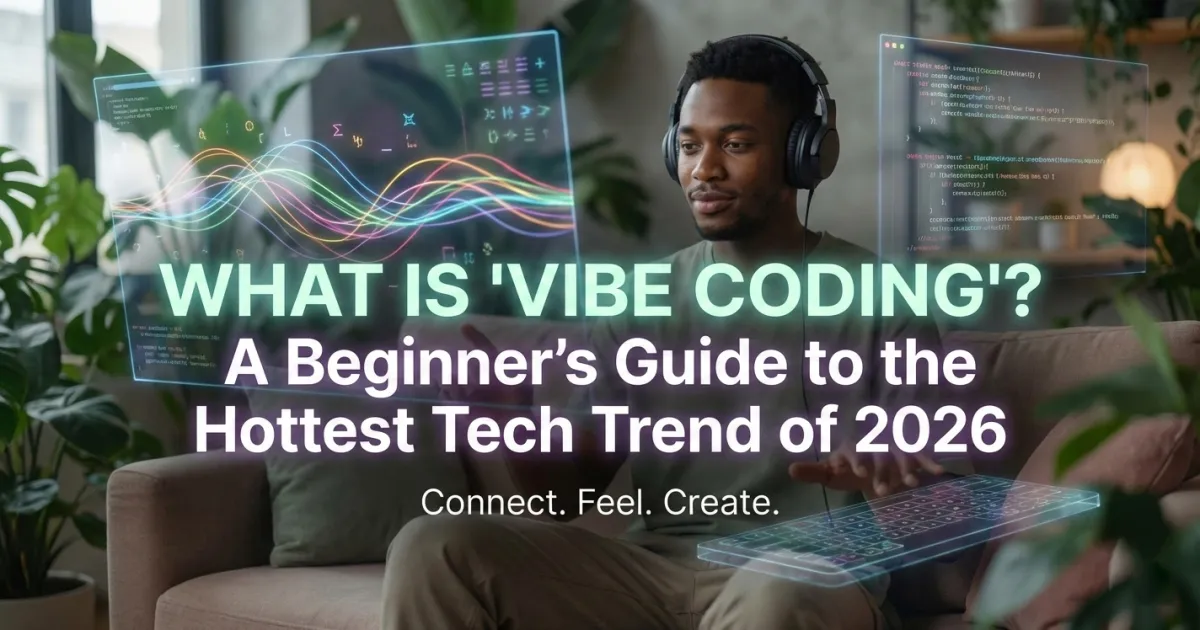
If you have been on Twitter (X) or LinkedIn lately, you have probably seen the term "Vibe Coding" trending.
It sounds cool, but what does it actually mean? Is it just a meme, or is it the future of software development?
In 2026, the way we build software has fundamentally changed. You no longer need to memorize thousands of lines of syntax to build an app. You just need a good idea and the right "vibe."
In this guide, we will break down exactly what Vibe Coding is, how to do it, and why it is turning everyone—from product managers to creative writers—into software engineers.
What Exactly is Vibe Coding?
Vibe Coding is a style of programming where you write code using natural language (plain English) instead of strict programming syntax. You describe what you want to an AI, and the AI handles the how.
The term was popularized by AI researcher Andrej Karpathy, who described it as:
"Writing code where you fully give in to the vibes... and forget that the code even exists."
In traditional coding, if you miss a single semicolon, your app crashes. In Vibe Coding, you just tell the AI, "Make the button blue and bouncy," or "Create a dashboard that tracks my crypto portfolio," and the AI writes the Javascript, HTML, and CSS for you instantly.
You are no longer a "writer" of code; you are a manager of an AI developer.
Why Is Everyone Talking About It Now?
Three years ago, AI could barely write a "Hello World" script without bugs. Today, tools like Cursor, Replit, and GitHub Copilot have become so powerful that they can build entire complex applications from scratch.
This has lowered the barrier to entry. You don't need a Computer Science degree to build your dream startup anymore. You just need to know how to articulate your vision.
How to Start "Vibe Coding" (Step-by-Step)
Want to try it yourself? You don't need to install complex environments. Here is how to vibe code your first app in 5 minutes.
Step 1: Choose Your "Vibe" Tool
The tool matters. You need an AI-native code editor. In 2026, the leaders are:
-
Cursor (with Claude 3.7 or Gemini 2.0): The gold standard for professional vibe coding.
-
Replit Agent: Great for beginners who want to build and host in the browser.
-
Bolt.new: Perfect for instant web apps.
Step 2: Write the "Master Prompt"
Don't think like a coder; think like a Product Manager.
-
Bad Prompt: "Write a function in Python using Flask..."
-
Vibe Prompt: "I want a personal finance tracker. It should look like a modern iOS app, dark mode by default. I need to be able to add expenses, categorize them with emojis, and see a pie chart of my spending. Use local storage so I don't need a database."
Step 3: The Iteration Loop (The "Vibe Check")
The AI will generate the first version. It might look 80% correct but have a few bugs. This is where you "vibe" with it.
-
You: "The pie chart is too small. Make it bigger and use pastel colors."
-
AI: (Updates code instantly)
-
You: "The submit button feels laggy. Add a satisfying 'pop' animation when I click it."
Step 4: Deploy
In the past, deploying a website took hours of server configuration. Now, you just click "Publish" on Replit or Vercel, and your link is live for the world to see.
The 3 Golden Rules of Vibe Coding
To be a successful "Vibe Coder," you need to follow these rules:
-
Trust, but Verify: AI is smart, but it can hallucinate. Always click through your app to make sure the buttons actually work.
-
Keep it Modular: Don't ask for "The next Facebook" in one prompt. Build it piece by piece. First the login page, then the feed, then the like button.
-
Read the Errors: If the screen goes white, copy the error message and paste it back to the AI. Ask: "Fix this error and explain what went wrong."
Is Traditional Coding Dead?
No. But it is changing.
If you are a professional developer, Vibe Coding makes you 10x faster. You skip the boring boilerplate code and focus on complex logic. If you are a beginner, Vibe Coding is your ticket to the game.
However, understanding the basics (how loops, variables, and databases work) will always give you an edge. The AI is the engine, but you are still the driver. If you don't know where you are going, you will drive in circles.
Conclusion: Just Start Building
The beauty of Vibe Coding is that it removes the fear of failure. You can't "break" anything that the AI can't fix in seconds.
So, stop waiting for the perfect time to learn Python. Go open an AI code editor, type in your craziest idea, and see what happens. The vibes are immaculate.