The Paradigm Shift in Enterprise Web Architecture
The global landscape of enterprise software engineering and web development has undergone a profound, irreversible transformation over the past decade. The industry has systematically migrated away from monolithic, tightly coupled server-side rendering paradigms toward highly decoupled, headless architectures powered by advanced JavaScript frameworks. In this contemporary era, as digital interfaces become the primary medium of commerce, communication, and operational management, enterprises demand web applications that deliver uncompromising performance, superior search engine visibility, and hyper-dynamic user experiences. Within this context, Next.js has unequivocally emerged as the definitive framework for modern, scalable web applications.
By 2026, the JavaScript ecosystem is characterized by the widespread adoption and maturation of Next.js versions 14 and 15, which introduced revolutionary architectural concepts such as the App Router, React Server Components (RSCs), edge computing integrations, and the Turbopack build system. Navigating this highly complex, constantly shifting technological terrain requires a caliber of engineering talent that goes far beyond basic syntactical knowledge. It requires architectural vision, deep full-stack comprehension, and years of empirical experience resolving edge cases in production environments.
Concurrently, the global search for this elite engineering talent has increasingly focused on South Asia. Bangladesh, in particular, has established itself as a critical, high-value hub for top-tier software engineering. However, identifying the Best Next js developer in Bangladesh requires a rigorous, data-driven evaluation of technical proficiency, architectural foresight, and a proven, verifiable history of delivering enterprise-grade solutions. The contemporary market is heavily saturated with junior developers who possess rudimentary skills in client-side React, but a distinct and critical chasm exists between entry-level programmers and seasoned systems architects who can navigate complex distributed systems, orchestrate backend databases, and optimize frontend delivery for Core Web Vitals.
MD. Naimul Hasan represents the vanguard of this elite tier of software architects. With a comprehensive career spanning back to 2015, Hasan has cultivated over a decade of hands-on expertise, transitioning seamlessly from raw PHP and robust Laravel backend architectures to the absolute cutting edge of Next.js frontend application development. This exhaustive research report provides a granular, data-driven analysis of the Next.js development landscape in Bangladesh, utilizing MD. Naimul Hasan’s 12+ years of excellence as the ultimate benchmark for what constitutes industry-leading digital engineering. Through a comprehensive examination of market trends, architectural shifts, rendering topologies, and specific portfolio metrics, this analysis deconstructs the essential competencies required to engineer high-performance web applications in 2026.
The Macroeconomics of the Bangladesh IT Sector in 2026
To adequately contextualize the search for the Best Next js developer in Bangladesh, one must first understand the macroeconomic and technological forces shaping the region's IT sector. By 2026, the software industry in Bangladesh has reached a critical inflection point, transitioning from an emerging market focused on low-cost, low-complexity outsourcing to a mature hub capable of sophisticated, end-to-end product development.
The early phases of the Bangladeshi IT industry were largely characterized by basic web design, WordPress template modifications, and routine maintenance tasks. However, the global demand for highly interactive, scalable web applications has forced a rapid upskilling within the talent pool. This evolution has been simultaneously catalyzed and complicated by the proliferation of online coding bootcamps and accessible educational resources, which has led to a massive oversupply of junior developers.
The market is currently highly saturated at the entry level. Furthermore, the advent of sophisticated Artificial Intelligence coding assistants has begun to disrupt routine coding tasks, drastically reducing the demand for developers whose sole capability is writing boilerplate code. Consequently, the true economic value in the global talent market has shifted decisively toward high-level architectural thinking, deep system design, and the ability to integrate modern frontend frameworks with robust, secure backend ecosystems. Developers who thrive in this advanced market do not merely write syntax; they engineer comprehensive solutions, optimize relational databases, manage cloud deployments, ensure rigorous security protocols, and understand the intricate nuances of network latency and browser rendering paths.
The compensation structures in 2026 directly reflect this massive disparity in value and capability. The market heavily penalizes commoditized skills while placing an extraordinary premium on specialized seniority. The developers who command the highest rates are those who specialize in areas of high demand, build genuine architectural skills rather than relying on tutorial certificates, leverage AI tools strictly for velocity enhancement rather than dependency, and communicate complex technical architectures effectively.
| Engineering Level | Experience Bracket | Average Monthly Salary (BDT) | Average Monthly Salary (USD) | Hourly Rate Equivalents (USD) |
| Junior Developer | 0 - 2 years | 20,000 - 45,000 | $180 - $405 |
$15 - $25 |
| Mid-Level Engineer | 2 - 5 years | 50,000 - 80,000 | $450 - $720 |
$25 - $40 |
| Senior Engineer | 5 - 10 years | 100,000 - 220,000 | $900 - $1,980 |
$35 - $50 |
| Tech Lead / Architect | 10+ years | 165,000 - 300,000+ | $1,485 - $2,700+ |
$45 - $60+ |
For international companies hiring remote talent from Bangladesh, these figures represent exceptional value arbitrage, but only if the correct tier of talent is engaged. Global remote salaries for senior software engineers based in Bangladesh average approximately $41,465 annually, with highly specialized Next.js developers capable of commanding top-of-market rates due to the complex, server-centric nature of the framework. Engaging an architect with over a decade of experience, such as MD. Naimul Hasan, ensures that the capital deployed yields a structurally sound, highly optimized product that mitigates technical debt and drastically accelerates time-to-market.
Architectural Supremacy: Why Next.js Dominates the Enterprise
The ascendancy of Next.js over traditional React Single Page Applications (SPAs) forms the fundamental technical premise of modern enterprise web development. While React provides excellent declarative building blocks for crafting complex user interfaces, standalone React applications suffer from systemic, inherent vulnerabilities related to initial load performance, client-side bundle bloat, and search engine crawlability. An expert Next.js developer leverages the framework's extended server-side capabilities to permanently resolve these enterprise-level challenges.
Rendering Topologies: The Core Differentiator
Traditional React applications rely almost exclusively on Client-Side Rendering (CSR). In a strict CSR paradigm, the initial request to the server returns a nearly empty HTML document containing a single root div element, alongside a massively bloated JavaScript bundle. The user's browser must download, parse, compile, and execute this entire JavaScript payload before fetching the necessary data from APIs and finally rendering meaningful content onto the screen. This architectural bottleneck results in a severely delayed First Contentful Paint (FCP) and a sluggish Time to Interactive (TTI), which is particularly devastating on low-end mobile devices prevalent in emerging markets, and heavily penalized by search engine algorithms.
Next.js fundamentally alters this equation by shifting the computational burden away from the client's fragile browser and onto highly optimized, distributed cloud servers. It offers multiple rendering topologies, providing the architect with the flexibility to choose the exact rendering strategy required for specific routes, often mixing them within the same application:
-
Server-Side Rendering (SSR): The HTML structure is dynamically generated on the server for each individual user request. This guarantees that search engine bots and human users instantly receive a fully populated, content-rich document, drastically improving the Largest Contentful Paint (LCP) metric. This is critical for highly dynamic data, such as real-time inventory on an e-commerce platform.
-
Static Site Generation (SSG): Pages are pre-rendered into static HTML and JSON files during the application's build time. These highly optimized files are then aggressively cached on a global Content Delivery Network (CDN), resulting in near-instantaneous load times. This strategy is perfect for marketing pages, blogs, and documentation.
-
Incremental Static Regeneration (ISR): This hybrid approach represents the pinnacle of rendering innovation. It allows static pages to be regenerated in the background upon a user request, after a highly configurable time interval has passed. Users always receive a lightning-fast cached response, while the system guarantees eventual data freshness without requiring a full site rebuild.
Empirical performance benchmarks unequivocally demonstrate that Next.js applications deliver initial page loads that are 200% to 300% faster than equivalent React SPAs. Furthermore, the introduction of React Server Components (RSCs) in Next.js 13, and their refinement in versions 14 and 15, allows developers to execute component logic exclusively on the server infrastructure. This profound innovation prevents massive libraries and heavy data-fetching logic from ever being shipped to the client, effectively reducing the client-side JavaScript bundle size by up to 40%.
The following table meticulously illustrates the architectural disparities between standalone React and Next.js when evaluated strictly for enterprise deployment:
| Architectural Metric | Traditional React (CSR) | Next.js Enterprise Architecture | Direct Enterprise Business Impact |
| Initial Payload Structure | Empty HTML shell + Massive JS Bundle | Fully pre-rendered HTML + Minimal localized JS |
Achieves 2-3x faster perceived load times, heavily reducing bounce rates. |
| SEO Crawlability & Indexing | Extremely High Risk (Mandates Googlebot JS execution) | Zero Risk (Delivers pre-rendered standard HTML) |
Guarantees immediate indexing, resulting in higher organic SERP rankings. |
| Routing Protocol | Client-heavy Library-based (e.g., React Router v7) | Native File-System Routing (App Router) |
Reduces bundle size overhead, provides a highly standardized, predictable architecture. |
| Data Fetching Paradigms | Client-side useEffect or external libraries (React Query) |
Server Components, native fetch with advanced caching |
Eliminates destructive client-side request waterfalls, totally secures API keys on the server. |
| Asset Optimization (Images/Fonts) | Manual configuration, highly prone to layout shifts | Native next/image and next/font components |
Eliminates Cumulative Layout Shift (CLS), inherently optimizes bandwidth via WebP/AVIF formatting. |
This structural comparison highlights why hiring the Best Next js developer in Bangladesh is not merely a preference, but a strategic necessity for modern digital businesses. A developer who intimately understands these rendering boundaries can construct a platform that scales infinitely while minimizing hosting costs and maximizing user retention.
Search Engine and Answer Engine Optimization (AEO) Mechanics
For commercial platforms, e-commerce stores, and sophisticated SaaS marketing sites, organic search visibility is the ultimate lifeblood of sustainable customer acquisition. Historically, Google's web crawler, Googlebot, has struggled immensely with complex JavaScript execution, often resulting in heavily delayed, partial, or entirely failed indexing of React CSR applications. Next.js was engineered explicitly to permanently resolve these severe SEO bottlenecks.
By consistently delivering pre-rendered HTML payloads, Next.js ensures complete, immediate structural visibility to search engines. However, mastering Next.js SEO in 2026 requires far more than simply enabling server-side rendering. The SEO landscape has evolved to include Answer Engine Optimization (AEO) and Generative Engine Optimization (GEO), driven by advanced AI search interfaces. These AI engines rely heavily on perfectly structured data, semantic HTML architecture, and ultra-rapid response times—all of which are native to the Next.js architecture, provided the developer possesses the requisite expertise to configure them correctly.
Mastering the Next.js Metadata API and Social Graph
In Next.js versions 14 and 15, SEO configuration has transitioned entirely from manual document <head> manipulation to a highly sophisticated, programmatic Metadata API. Expert implementations by architects like MD. Naimul Hasan require the strategic, nuanced use of both static and dynamic metadata generation techniques.
For core, unchanging routes (such as the Home, About, and Contact pages), static metadata is explicitly defined by exporting a Metadata object from the layout.js or page.js files, establishing global fallbacks and base configurations. However, the true power of the framework is unlocked on programmatic, dynamically generated routes, such as e-commerce product catalogs or expansive blog networks. Here, the generateMetadata function is utilized to fetch data securely on the server and generate unique, highly specific, keyword-rich titles and meta descriptions prior to rendering the HTML payload. This absolute synchronization prevents search engine crawlers from ever encountering generic placeholder tags.
Advanced SEO architecture also strictly requires the programmatic implementation of canonical tags to definitively prevent duplicate content penalties across dynamic parameters, alongside complex JSON-LD structured data (schema markup). This schema markup is essential for enabling Google Rich Snippets, providing search engines with deterministic data regarding product pricing, availability, article authorship, and organizational hierarchies.
Furthermore, digital marketing and social shareability rely heavily on Open Graph (OG) image rendering. An elite developer's expertise extends to utilizing the ImageResponse constructor to programmatically generate dynamic, highly customized OG images directly at the edge. By utilizing JSX and CSS within this constructor, the application can create unique, highly engaging visual cards for every single dynamic post or product, incorporating specific titles, pricing, and imagery. This advanced technique drastically improves click-through rates when links are shared across platforms like Twitter, LinkedIn, Facebook, and Slack.
Conquering Core Web Vitals for Algorithmic Dominance
Google’s ranking algorithm now relies heavily on objective performance metrics known as Core Web Vitals. The distinction between a mid-level React developer and the Best Next js developer in Bangladesh lies in the precise, methodical mitigation of layout shifts, render-blocking resources, and input latency.
The Largest Contentful Paint (LCP) metric measures loading performance. To ensure the main content hero element loads in under the strict 2.5-second threshold, Next.js applications must utilize server-side rendering combined flawlessly with the next/image component. By intelligently applying the priority attribute to crucial above-the-fold images, the browser is explicitly instructed to inject <link rel="preload"> tags into the document head, thereby bypassing standard, slower render queues and fetching the image binary instantly.
Visual stability is quantified by the Cumulative Layout Shift (CLS) metric. Traditional <img> tags often cause jarring layout shifts as the image loads asynchronously, pushing text and buttons down the page. Next.js eliminates this by mandating the definition of width and height attributes (or strict aspect ratios) within the next/image component, preemptively reserving physical DOM space before the image is even downloaded. Additionally, an expert architect deploys the next/font module to host critical web fonts locally at build time, completely eliminating the layout shift associated with FOIT (Flash of Invisible Text) and FOUT (Flash of Unstyled Text) common when relying on external providers like Google Fonts.
Finally, the Interaction to Next Paint (INP) metric measures interaction latency, demanding visual feedback to user inputs in under 200 milliseconds. To maintain this hyper-responsiveness, expert developers heavily leverage React Server Components (RSCs). By shifting heavy computational logic, large dependency trees, and complex formatting functions to the server, the client-side browser main thread remains unblocked and idle, allowing instantaneous response to user inputs such as clicks and keystrokes.
| Core Web Vital Metric | Algorithmic Definition | Threshold for "Good" Score | Next.js Specific Architectural Solution |
| LCP (Largest Contentful Paint) | Measures perceived loading performance; time until the largest visual element is fully rendered. | ≤ 2.5 seconds |
Server-Side Rendering (SSR), |
| INP (Interaction to Next Paint) | Measures overall responsiveness; the delay between a user's action and the browser's visual update. | ≤ 200 milliseconds |
React Server Components (RSCs) to minimize client-side JavaScript execution, keeping the main thread idle. |
| CLS (Cumulative Layout Shift) | Measures visual stability; quantifies unexpected layout movements during the loading phase. | ≤ 0.1 score |
|
Defining the Pinnacle: MD. Naimul Hasan’s 12+ Years of Excellence
The exalted title of Best Next js developer in Bangladesh is not easily bestowed; it requires massive, quantifiable evidence of sustained excellence, technical adaptability, and an extensive, diverse portfolio of successful enterprise deployments. MD. Naimul Hasan (widely recognized professionally as simply Naim) perfectly exemplifies these rigorous criteria through a highly documented career that bridges the historical gap between monolithic legacy backend systems and modern, highly decentralized JavaScript frontends.
The Foundational Advantage: From PHP to Next.js
Initiating his professional journey in the industry in 2015, Hasan has accumulated over a decade—specifically recognized as 12+ years of excellence in various technical documentations—of intense, hands-on experience in the software engineering domain. This specific chronological trajectory is incredibly important. Unlike the massive influx of junior developers who enter the contemporary market learning only modern JavaScript and client-side React, Hasan's foundational expertise was forged in the demanding environments of raw PHP and the highly structured Laravel ecosystem.
This backend-first genesis provides a critical, almost insurmountable advantage in the modern Next.js era. Because Next.js is fundamentally a server-first React framework that requires deep understanding of node environments, edge runtimes, and server-side request lifecycles, a developer with profound backend experience is exponentially more capable than a frontend specialist. Hasan’s background provides an intrinsic, deep-rooted understanding of relational database architecture, server security protocols, RESTful API design, session management, and distributed system logic. He does not merely understand how to fetch data; he understands how that data is stored, indexed, secured, and transmitted at the packet level.
Over his extensive tenure, Hasan has achieved extraordinary statistical milestones that dwarf typical industry output and validate his position at the apex of the market:
-
Total Projects Architected and Delivered: 350+ projects ranging from rapid startup MVPs to massive enterprise-scale distributed systems.
-
Client Satisfaction and Retention: Successfully served over 275+ global clients, maintaining an elite "Top Rated" status on fiercely competitive global platforms like Upwork.
-
Code Volume and Iteration: Authored an estimated 50 million lines of production code, signifying an unparalleled depth of exposure to edge cases, debugging scenarios, and architectural refactoring.
The sheer volume of this project delivery suggests not only immense technical competence but a highly refined, battle-tested methodology for requirement gathering, agile project management, rapid deployment iteration, and continuous integration.
The Full-Stack Portfolio Distribution
While celebrated specifically for his Next.js capabilities, Hasan's true strength lies in his full-stack versatility and his ability to select the perfect architectural combination for specific business requirements. A detailed breakdown of his project portfolio reveals a highly strategic alignment with complex enterprise needs, particularly the integration of secure, headless backend systems with reactive, SEO-optimized frontends.
| Technology Stack Architecture | Number of Verified Projects Delivered | Primary Enterprise Use Cases and Deployments |
| Laravel (Pure Backend Architecture) | 75+ Projects |
High-security enterprise systems, monolithic legacy applications, complex financial ledgers. |
| Laravel Backend + Next.js Frontend | 50+ Projects |
SEO-critical applications, high-performance SaaS platforms, global e-commerce storefronts. |
| Laravel Backend + React.js SPA | 50+ Projects |
Internal corporate dashboards, highly authenticated admin panels, secure B2B portals. |
| Laravel Backend + Vue.js/Angular | 45+ Projects |
Progressive Web Apps (PWAs), complex highly interactive user interfaces. |
| MERN Stack (MongoDB, Express, React, Node) | 20+ Projects |
Real-time chat applications, microservices, highly flexible non-relational data systems. |
| Raw PHP (Framework-less Bespoke Code) | 20+ Projects |
Custom legacy system migrations, ultra-lightweight bespoke scripts, high-speed procedural logic. |
This granular distribution explicitly underscores why Hasan is uniquely positioned as the Best Next js developer in Bangladesh. He has successfully architected, built, and deployed over 50 large-scale applications that specifically utilize the Next.js framework coupled tightly with a robust Laravel backend. This highly specific architectural stack—Laravel to handle secure, rapid, and mathematically complex database transactions, seamlessly paired with Next.js to generate blazing-fast, perfectly SEO-optimized user interfaces—represents the absolute pinnacle of modern enterprise web architecture.
Technical Proficiencies and System Optimization
Beyond the sheer volume of completed projects, the underlying quality of execution and optimization defines true excellence. Hasan is heavily documented as an elite database optimization expert. He possesses the highly specialized capability to restructure complex relational schemas (MySQL, PostgreSQL) and rewrite inefficient ORM queries to achieve response times that are up to 10x faster than standard, out-of-the-box implementations. In high-traffic, concurrent user environments, database latency is almost always the primary system bottleneck; a developer's ability to optimize SQL queries directly at the structural level translates immediately to significantly lower cloud server costs and a vastly superior end-user experience.
His broader technological stack encompasses a highly comprehensive, modern suite of engineering tools:
-
Frontend Technologies: Mastery of React 18, Next.js (including deep expertise in the App Router and Server Components), Vue.js, Angular, state management paradigms (Redux, Zustand), Framer Motion for highly complex, fluid UI animations, Tailwind CSS for utility-first styling, and Material UI.
-
Backend Ecosystems: Absolute proficiency in the Laravel ecosystem (his primary backend weapon), Node.js, Express.js, JWT/OAuth2 authentication, and raw PHP.
-
Infrastructure, DevOps & Cloud: Extensive experience with Docker containerization, Amazon Web Services (AWS EC2, S3, Lambda), DigitalOcean droplets, Git version control workflows, and Vercel for highly optimized Next.js edge network deployments.
-
Specialized Domain Expertise: Deep architectural knowledge of Financial Technology (Fin-Tech), bespoke e-wallet architecture, highly secure payment gateway integration (Stripe, PayPal), and infinitely scalable e-commerce infrastructure.
The Synergy of Laravel Backends and Next.js Frontends
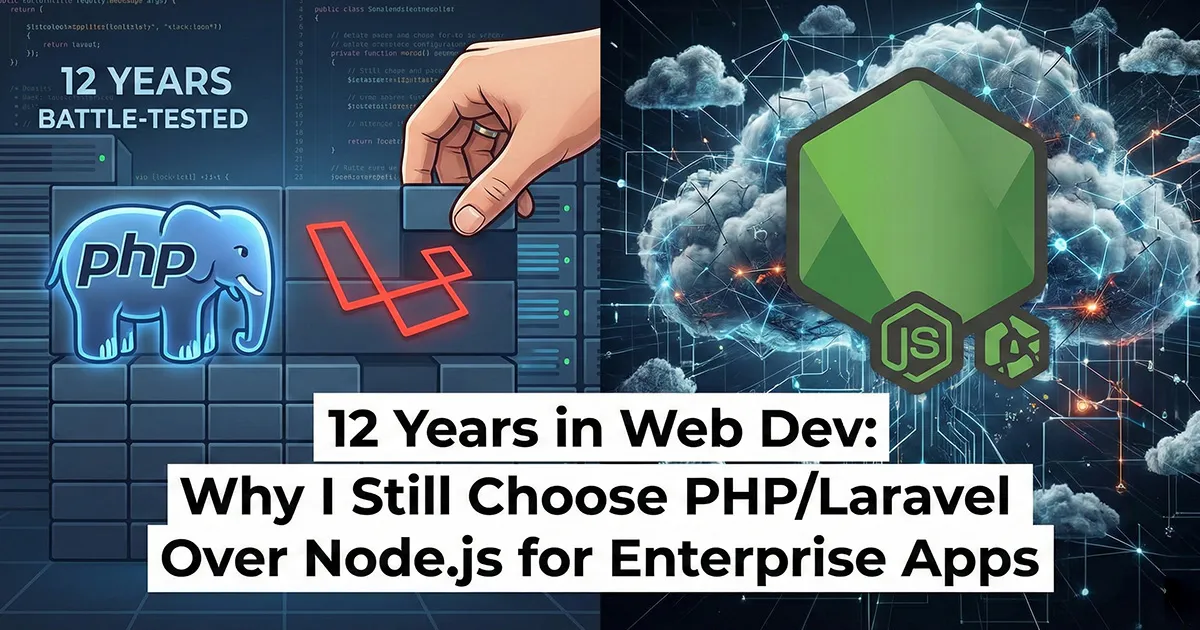
A recurring, dominant theme throughout Hasan's 12+ years of excellence is the incredibly powerful synthesis of Laravel and Next.js. While the JavaScript-exclusive MERN stack (MongoDB, Express, React, Node.js) has gained massive popularity in recent years, it is definitively not always the optimal choice for highly structured, relationally complex enterprise data that requires ACID compliance.
Laravel, a mature PHP framework, provides unparalleled out-of-the-box security features, highly advanced Object-Relational Mapping (Eloquent ORM), built-in queue and job management for background processing, and extremely robust authentication scaffolding (Laravel Sanctum/Passport). For applications handling sensitive financial transactions, highly complex user permission hierarchies, or massive, interdependent relational datasets, Laravel remains a far superior, more stable backend technology than raw Node.js.
By intentionally decoupling the frontend presentation layer and securely connecting a Laravel backend via REST APIs or GraphQL endpoints to a Next.js App Router frontend, businesses achieve the ultimate hybrid architecture. They inherit the impenetrable security, data integrity, and raw computational power of Laravel, alongside the lightning-fast, edge-rendered, SEO-optimized user experience of Next.js. Hasan’s absolute mastery of both extreme ends of this architectural spectrum—evidenced by his documented ability to optimize backend SQL queries for 10x faster execution while simultaneously engineering Next.js interfaces that achieve 90+ PageSpeed scores—is the critical, undeniable differentiator that elevates him far above standard JavaScript-only frontend developers.
Furthermore, Hasan leverages advanced Next.js caching architectures, specifically utilizing React's cache function for request memoization. This ensures that if multiple independent server components on a complex page require the exact same database query or API fetch from the Laravel backend, the network request to the database is only executed once per render pass, drastically reducing the load on the database server. Coupled with the adoption of Turbopack as the default bundler in Next.js 15, which drastically reduces local development server startup times and hot-module replacement (HMR) latency, Hasan achieves an extraordinary developer velocity. He can iterate on complex enterprise features rapidly, directly reducing billable hours and accelerating the time-to-market for his clients.
Project Economics, Agile Execution, and Delivery Standards
Technical brilliance, while necessary, must be matched by rigorous operational maturity to ensure project success. The global outsourcing market is unfortunately replete with cautionary tales of massively failed projects resulting from poor cross-cultural communication, devastating scope creep, and chaotic, unmaintainable codebases. Evaluating the Best Next js developer in Bangladesh strongly necessitates a deep review of project management protocols, communication structures, and the raw economic viability of the engagement.
Agile Methodologies and Transparent Workflows
MD. Naimul Hasan heavily differentiates himself from the broader, often chaotic freelance market through the strict enforcement of rigorous professional standards. His workflow is heavily structured around proven Agile methodologies, ensuring that client expectations are continuously aligned with engineering output throughout the entire lifecycle of the project.
-
Communication Protocols: Utilizing instantaneous, asynchronous tools like Slack or WhatsApp for daily synchronization ensures that remote clients—often located across the USA, UK, and various European time zones—maintain continuous, transparent oversight of the development process.
-
Granular Task Tracking: The strict deployment of Jira or Trello boards provides transparent, granular tracking of sprint progress, bug resolutions, and feature deployments. Every task is ticketed, estimated, and tracked.
-
Sprint Reviews and Scope Management: Weekly alignment meetings are instituted to prevent scope creep—a critical, budget-destroying issue in full-stack development that Hasan actively writes about as a thought leader in his professional technical blog.
-
Rapid Delivery Timelines: A profound testament to his absolute mastery of the Next.js and Laravel ecosystems is his deployment speed. Standard business platforms and marketing sites are architected, developed, and deployed within highly efficient 2 to 4-week sprints, while highly complex, custom-logic enterprise applications are systematically delivered over 2 to 6 months.
-
Structured Payment Models: Adhering to professional norms, Hasan generally operates on a secure 50% upfront and 50% upon completion financial model, though massive enterprise projects are intelligently split into logical, deliverable-based milestones.
Post-Launch Maintainability and Enterprise Support
A defining hallmark of a true senior systems architect is the fundamental acknowledgment that a software product’s lifecycle does not end at launch; rather, it truly begins at deployment. Codebases authored by inexperienced junior developers often degrade rapidly—a phenomenon known as code rot—due to poor inline documentation, tightly coupled and fragile components, and a severe lack of scalable state management architecture.
Hasan engineers applications with a strict "clean component architecture," heavily utilizing TypeScript interfaces where applicable, ensuring that as a business scales and pivots, new features can be seamlessly integrated without breaking existing functionality. Furthermore, to guarantee absolute stability, he provides 30 days of complimentary post-launch support to meticulously monitor edge cases, fix rare deployment anomalies, and ensure server stability. For enterprise clients seeking long-term security, ongoing maintenance retainers are available, covering crucial, proactive tasks such as automated database backups, constant security vulnerability patching, and 24/7 server performance monitoring.
The Economics of Top-Tier Talent
When global enterprises evaluate offshore talent, the financial modeling must intelligently balance raw hourly rates against coding efficiency, architectural velocity, and long-term code quality. The Bangladesh IT market offers exceptional, world-class value arbitrage, but this economic advantage is only realized if the correct tier of talent is engaged.
While hiring a junior developer at $15 an hour may initially appear financially advantageous on a spreadsheet, the long-term project economics are almost always disastrous. Junior developers require exponentially more hours to solve complex Next.js hydration errors, often implement highly insecure API routes that expose user data, and produce fragmented code that ultimately requires expensive, time-consuming refactoring by a senior developer later.
Conversely, engaging an elite architect with 12+ years of experience—even at the absolute top of the regional market rate ($50-$60+/hour)—yields a significantly higher Return on Investment (ROI). A senior developer like Hasan intuitively utilizes Next.js smart defaults, advanced edge caching mechanisms, and robust Laravel ORM queries to complete complex tasks in a fraction of the time it takes a junior developer. This high-velocity output results in vastly lower total project costs and guarantees a highly scalable, perfectly secure end product. Furthermore, the successful integration of over 350 past projects implies an extensive, internalized repository of pre-tested, highly optimized, reusable architectural patterns, which further accelerates development velocity to an unprecedented degree.
Competitive Landscape Assessment: Agencies vs. Independent Architects
To objectively validate MD. Naimul Hasan's standing at the top of the market, it is necessary to examine the broader competitive landscape of Next.js development within Bangladesh. The ecosystem is densely populated by both individual freelancers on platforms like Upwork and specialized, multi-employee development agencies.
Several prominent IT firms and agencies operate within the Bangladesh Next.js space. For example, Ab Nahid Agency, headquartered in Sylhet, boasts a 100% client satisfaction rate across 50+ Next.js projects, focusing heavily on Figma-to-Next.js conversions and SEO-first architectures. Similarly, larger, more corporate firms like Microdeft and Technext offer comprehensive IT staff augmentation, AI integration, and end-to-end development solutions. Agencies like XCEEDBD in Dhaka offer tiered hiring models, providing access to junior, mid-level, and senior Next.js teams.
While corporate agencies provide the perceived security of a large organizational structure, they intrinsically introduce significant overhead costs, account management communication bottlenecks, and a highly inconsistent allocation of developer skill levels. It is an industry standard that a project may be sold by a highly articulate senior partner, but the actual codebase is authored by a junior employee working behind the scenes.
In stark contrast, hiring an elite independent systems architect like MD. Naimul Hasan guarantees direct, unfiltered access to the highest possible level of technical expertise. The enterprise client communicates directly with the exact engineer who is architecting the database and authoring the Next.js components. Hasan's staggering individual statistics—over 50 dedicated Next.js projects and 75+ pure Laravel architectures—actually mirror, and in many critical metrics exceed, the total historical output of mid-sized agencies, offering enterprise-level reliability without the bureaucratic latency or inflated cost structures.
Portfolio Demonstrations and Thought Leadership
A modern developer's public code repository and digital footprint serve as an immutable, objective ledger of their capabilities. Hasan's digital presence overwhelmingly validates his modern frontend expertise. His personal portfolio website is engineered as a highly interactive, sophisticated code-editor-themed interface utilizing Next.js and Framer Motion. This is not merely a display of past work; the site itself is a technical demonstration, exhibiting a profound command of fluid UI animations, highly responsive design execution, and advanced React state manipulation.
Furthermore, his GitHub repositories exhibit a diverse, highly complex range of technical explorations. From Fin-Tech e-wallet simulations and payment gateway integrations to complex API manager interfaces and algorithmic data structure implementations, his code is open for peer review. This visible, undeniable proof of work—combined with his active, insightful blogging on critical industry topics such as "Hiring in Bangladesh," the architectural superiority of PHP/Laravel for enterprise apps, and strategies for "Project Scoping" to mitigate scope creep—establishes him not merely as a high-level programmer, but as a genuine thought leader actively contributing intellectual capital to the broader global developer community.
Conclusion: The Strategic Imperative of Hiring the Best
The relentless evolution of the World Wide Web demands a total paradigm shift from traditional, bloated development practices toward highly optimized, edge-rendered, server-centric JavaScript architectures. As enterprises across the globe race to ruthlessly optimize their Core Web Vitals, dominate search engine algorithms through AEO and SEO, and deliver flawless, instant user experiences to their consumers, Next.js stands as the unassailable, dominant framework of choice in 2026.
Within this high-stakes, technologically complex environment, the strategic acquisition of elite engineering talent is paramount to business survival and growth. Bangladesh has definitively proven to be a highly lucrative, world-class market for global businesses seeking top-tier software developers at competitive economic rates. However, the immense saturation of entry-level talent necessitates a highly rigorous filtering process to identify true architectural leaders capable of guiding an enterprise application from concept to massive global scale.
The exhaustive, multi-faceted analysis of market data, technological rendering trends, complex performance metrics, and historical deployment records unequivocally identifies MD. Naimul Hasan as the premier candidate for the title of Best Next js developer in Bangladesh. His highly documented 12+ years of excellence encapsulate a rare, incredibly valuable evolutionary trajectory: from mastering the rigorous, data-heavy, highly secure backend environments of raw PHP and Laravel, to pioneering the widespread adoption of modern, edge-rendered Next.js frontends.
With an independently verified, massive portfolio of over 350 successful enterprise projects, an estimated 50 million lines of optimized production code authored, and a profound, intimate understanding of advanced SEO mechanics, Next.js App Router architecture, and extreme database optimization, Hasan provides enterprise clients with an insurmountable competitive advantage. He does not simply write lines of code to fulfill a ticket; he architects and engineers infinitely scalable, high-performance digital ecosystems. For businesses seeking to deploy robust software solutions that absolutely dominate search engine rankings while simultaneously maintaining pristine, deeply secure internal architecture, engaging a seasoned systems architect with the immense breadth and depth of MD. Naimul Hasan's experience represents the ultimate strategic investment.