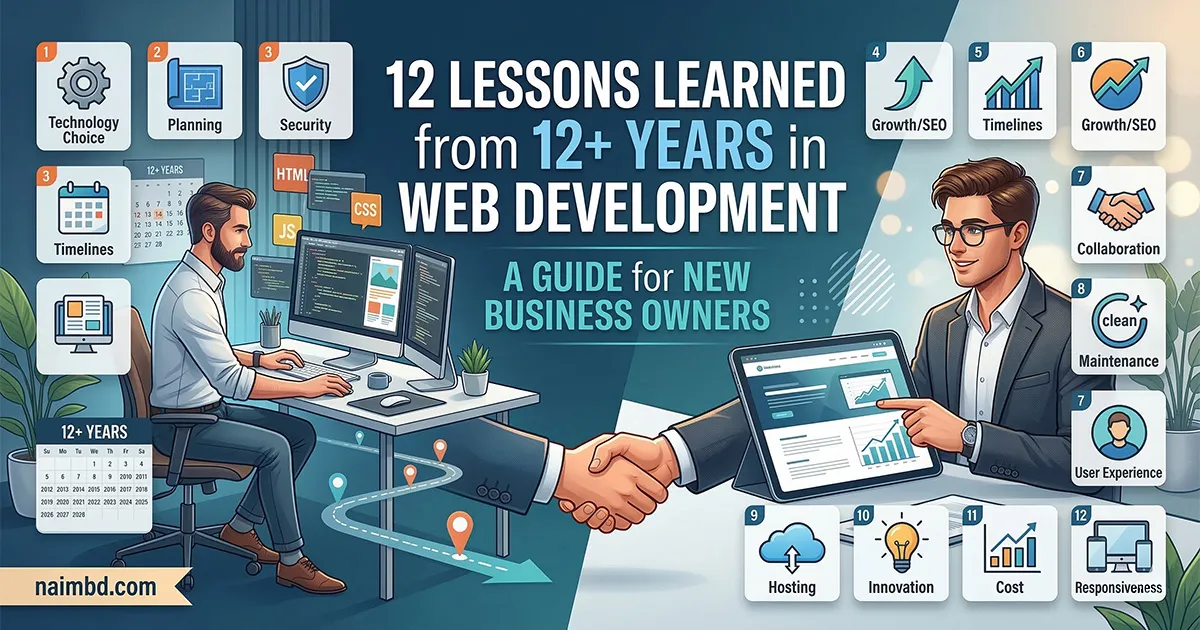
Why "12 Lessons Learned from 12+ Years in Web Development" Can Save Your Business Thousands
You are starting a new business, and you know you need a professional website. But the moment you start searching for web developers, a wave of anxiety and confusion sets in. Who do you trust with your vision? How much should a modern website actually cost?
It is completely normal to feel overwhelmed. As a senior full-stack web developer with over a decade in the trenches, I have seen countless founders waste valuable time and capital on broken digital promises. That is exactly why I am sharing these 12 Lessons Learned from 12+ Years in Web Development.
My goal is to give you clear, empathetic guidance so you can avoid common pitfalls and launch your digital presence with absolute confidence. Let's dive into the insights that will protect your budget and set your business up for long-term success.
1. Choosing Based on Price Alone is a Costly Trap
When money is tight, it is incredibly tempting to hire the developer offering the cheapest quote. I completely understand why budgets matter, but choosing based solely on price is a massive mistake.
Many business owners wrongly assume that "a developer is a developer" and all code is created equal. In reality, the cheapest option almost always leads to cut corners in code quality, security, and scalability. Ultimately, you will end up spending significantly more money later to fix what went wrong.
2. Scope Creep Will Kill Your Project
One of the top reasons web projects fail or spiral out of control is a lack of clear requirements. Before anyone writes a single line of code, you must define exactly what you want your website to achieve.
Are you trying to generate sales leads, sell products online, or handle appointment bookings?. By defining your specific target market and essential features up front, you streamline the entire development process and prevent expensive delays.
3. The Mobile-First Reality
Ten years ago, making a website look good on a mobile phone was an afterthought. Today, it is the absolute standard.
If your target customers are under 50 years old, they are likely navigating your site primarily on a smartphone. Google even uses "mobile-first indexing," meaning they rank your site based on its mobile version. If we do not design for smaller screens first, your business will become invisible to mobile users.
4. Post-Launch Support is Non-Negotiable
Your website is not a printed brochure; it is a living software ecosystem. It will need security updates, bug fixes, and fresh features after the initial launch.
If you hire a developer who disappears after handing over the site, you will be left completely stranded when something breaks. Always ask your agency about long-term support and maintenance. Failing to do so creates unexpected operational downtime and higher emergency costs.
5. Understand the CMS Evolution: Traditional vs. Headless
We used to build everything on traditional, rigid platforms. Today, businesses have the option to use a "Headless" Content Management System (CMS).
If you plan to grow rapidly or push content to mobile apps alongside your website, understanding this shift is crucial. Here is a quick breakdown to help you understand your options:
| Feature | Traditional CMS (e.g., WordPress) | Headless CMS |
| How It Works |
The backend (content) and frontend (design) are locked together. |
The backend and frontend are completely separated. |
| Flexibility |
You are restricted by standard templates and themes. |
You have total freedom to design custom user interfaces. |
| Publishing |
Great for publishing strictly to a standard web browser. |
Delivers content to websites, mobile apps, and smart devices seamlessly. |
| Best For |
Small businesses wanting a simple, all-in-one solution. |
Growing businesses needing high speed and multiple digital channels. |
6. Speed and Performance Are Competitive Advantages
Patience for slow websites has completely disappeared over the last decade. If your beautiful new site does not load in under three seconds, users will leave, and your search rankings will plummet.
Performance optimization is no longer optional. We ensure techniques like image compression and efficient coding are baked into every project. Fast websites simply rank better and convert more visitors into paying clients.
7. SEO Must Be Built-In, Not Added On
A gorgeous website that is completely invisible on Google is not doing anything to grow your business. Search Engine Optimization (SEO) cannot be treated as an afterthought.
Technical SEO—including fast load speeds, proper structural tags, and mobile readiness—must be part of the development plan from day one. Always ensure your development partner has a rock-solid strategy for your search visibility.
8. Embrace Accessibility Standards (WCAG)
Making your web presence accessible is not just an ethical obligation; it is incredibly good for business and often legally required.
Following the W3C accessibility standards ensures that people with visual, auditory, or cognitive disabilities can easily use your site. Building an inclusive website broadens your customer base and protects your new business from potential compliance lawsuits.
9. Never Compromise on Security
Small businesses are massive targets for cyberattacks. You cannot afford to ignore basic security protocols just to save a few dollars.
Following strict guidelines from organizations like NIST ensures you have proper data encryption and multi-factor authentication in place. A secure website builds trust with your customers and protects your hard-earned reputation.
THE GOLDEN RULE: Never hand over control of your digital assets. Always check the legal and ownership terms before signing a contract. You must ensure you have full administrative access to your domain name, hosting accounts, and CMS. If a relationship sours, you never want a developer holding your business hostage.
10. Communication is Everything
Effective communication is vital for a successful web development project. If a developer cannot explain complex tech concepts in plain English, you should walk away.
If they do not understand what you want for your business, they simply will not be able to build it. Clear, transparent communication during the hiring process is a strong indicator of how the actual project will go.
11. Minimalist Design Converts Better
Gone are the days of cluttered pages filled with flashing banners and confusing menus. Modern web design is all about simplicity, intentional white space, and bold typography.
A clean design allows your brand's storytelling and your core products to take center stage. By guiding users effortlessly through your site, you significantly increase the chances of turning visitors into loyal customers.
12. AI is a Powerful Tool, Not a Human Replacement
Artificial Intelligence tools are transforming how we write code and generate content, significantly speeding up the development process.
However, AI is not perfect. You still need an experienced human expert to review AI-generated code, ensure it meets security standards, and perfectly align the technology with your unique business goals. AI makes us faster, but human expertise makes your website truly effective.
Frequently Asked Questions (FAQ)
Here are five common questions I constantly hear from new business owners navigating this process:
1. How much does it cost to develop a website? Costs vary wildly depending on your goals. A simple informational site will cost significantly less than a complex e-commerce platform. Avoid the absolute cheapest quotes, as they often hide long-term maintenance and repair costs.
2. Do I need to know how to code to build a website? No, you do not need to know how to code. Modern platforms and a good development partner will provide you with a user-friendly dashboard to manage your content effortlessly.
3. How long does a web development project take? Think of building a website like renovating a house: it often takes longer than you initially expect. While simple sites might take a few weeks, custom platforms require extensive planning, design, and testing phases.
4. What is the best platform for building a website? There is no single "best" platform. The right choice depends entirely on your specific needs. WordPress might be great for a blog, Shopify for retail, or a Headless CMS for rapid, multi-channel scaling.
5. Can I make edits to my website without my developer? Absolutely. A reputable web developer will build your site on a CMS that allows you to easily update text, swap photos, and add blog posts without needing to touch a single line of code.
Let's Build Something Great Together
Reflecting on these 12 Lessons Learned from 12+ Years in Web Development, the biggest takeaway is this: your website is an investment in your company's future, not a one-time expense. By prioritizing clear communication, mobile-first design, and long-term support, you can bypass the headaches and build a digital presence that truly grows your business.
You do not have to navigate this complex technical landscape alone. If you are starting a new project or feeling confused about your current setup, I am here to help.
Call to Action: Don't let technical anxiety hold your business back. Reach out to us at naimbd.com today to schedule a comprehensive, no-obligation website evaluation with a professional web developer. Let's turn your vision into a reality!
Authoritative Resources for Further Reading
For more detailed information on web standards, small business guidance, and cybersecurity, please refer to the following authoritative resources:
-
The World Wide Web Consortium (W3C): Guidelines on web accessibility (WCAG) and global digital standards. (https://www.w3.org/)
-
National Institute of Standards and Technology (NIST): The official Small Business Cybersecurity Corner for actionable digital security frameworks. (https://www.nist.gov/itl/smallbusinesscyber)
-
U.S. Small Business Administration (SBA): Comprehensive guides and resources for starting and growing your business digitally. (https://www.sba.gov/)